In the fast-paced world of distribution, a rejected order is more than just a missed transaction; it’s a cascade of lost opportunities, damaged relationships, and reduced revenue potential. As the industry adage goes, “You can’t manage what you can’t see,” and in the context of secondary sales, “blind” orders are the primary driver of fulfillment failure. For companies managing complex supply chains, order rejection rates can quietly erode profitability while competitors gain ground. Industry benchmarks suggest that even a 2% reduction in order rejection can lead to a 5-10% lift in overall distribution efficiency, yet many businesses treat these rejections as an unavoidable “cost of doing business” rather than a preventable operational leak.
Consider this: every rejected order represents not only lost immediate revenue but also potential long-term customer dissatisfaction. When distributors encounter frequent rejections, they begin diverting business elsewhere, creating a compounding effect that’s difficult to recover from. Yet, most businesses treat order rejections as inevitable rather than preventable.
The truth is different. By understanding the mechanics of order rejections and implementing systematic solutions, organizations can dramatically reduce rejection rates and unlock significant competitive advantages. This guide explores proven strategies for minimizing order rejections in secondary sales and building a resilient, efficient distribution ecosystem.
Understanding Order Rejection in Secondary Sales
Secondary sales represent a critical revenue stream for distributors and manufacturers alike. These are sales made to retailers, dealers, and other downstream partners who further distribute products to end consumers. Unlike primary sales (manufacturer to distributor), secondary sales involve multiple stakeholders, complex approval workflows, and greater susceptibility to errors.
An order rejection in this context occurs when an order placed by a secondary channel partner cannot be fulfilled, approved, or processed as requested. Common scenarios include:
- Out-of-stock situations: Inventory declared as available is no longer present
- Compliance failures: Orders don’t meet scheme or promotion eligibility requirements
- Quality issues: Products fail quality checks or are near expiration
- Credit or financial blocks: Distributor or retailer has outstanding dues or credit limits exceeded
- Documentation gaps: Missing or incomplete paperwork, invoices, or shipping details
- System mismatches: Data inconsistencies between multiple systems or platforms
The impact of these rejections extends beyond mere logistics. Each rejection creates friction in the distribution channel, increases administrative overhead, and often results in customer churn. Industry data suggests that organizations with high order rejection rates experience 25-40% lower distributor satisfaction scores and significantly longer sales cycles.
Why Poor Secondary Sales Tracking Leads to High Rejection Rates
Understanding why orders are rejected is the first step toward prevention. While rejections seem random, they often stem from common operational mistakes distributors make, specifically regarding data synchronization.
- Inventory Accuracy Issues
The most common culprit behind order rejections is inventory misalignment. When physical stock doesn’t match system records, orders are rejected to prevent overselling. This often occurs due to:
- Manual inventory tracking prone to human error
- Lack of real-time synchronization across warehouses
- Inadequate handling of returns, damages, or expired stock
- Untracked in-transit inventory
- Process Inefficiencies
Complex, manual order processing workflows are invitation for delays and errors. When orders require multiple approval layers without clear protocols, rejections become routine. Key problem areas include:
- Lack of standardized approval criteria
- Unclear responsibility assignments
- Bottlenecks in financial or compliance review
- Absence of escalation procedures for urgent orders
- Data Silos and Integration Gaps
Organizations using disconnected systems – separate ERP, CRM, and order management platforms- struggle with synchronization. When Secondary Sales Tracking data doesn’t flow seamlessly between systems, inconsistencies lead to rejections based on outdated information.
- Quality and Compliance Blind Spots
Orders may be rejected due to failing quality checks or not meeting promotional requirements. Common issues include:
- Expired or near-expiry products being offered
- Inconsistent scheme compliance (discounts, free goods not aligned with policy)
- Missing certifications or documentation
- Batch-specific quality issues not flagged in system
- Distributor and Channel Partner Capability Gaps
Not all order rejections originate from the supply side. Inadequately trained distributor teams may submit incomplete orders or fail to understand eligibility criteria. Lack of clear communication compounds this issue.
Strategic Interventions: Operational Excellence
Reducing order rejections requires a multi-layered approach that combines process improvement, technology enablement, and organizational change.
- Using Secondary Sales Tracking to Implementation Real-Time Inventory Control
Move away from periodic inventory checks toward continuous, real-time visibility:
- Deploy automated inventory tracking at all distribution points
- Implement dynamic buckets for saleable, non-saleable, and near-expiry products
- Enable inter-location stock transfers to prevent local stockouts
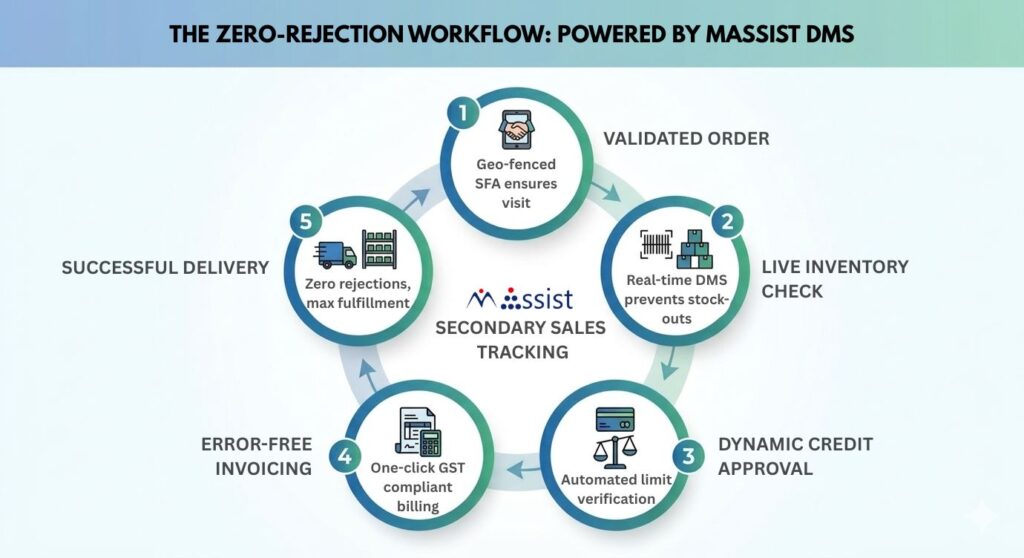
By establishing Real-Time Distribution Visibility, inventory systems reduce rejection rates by up to 35%.
- Establish Robust Approval Workflows
Define crystal-clear approval criteria and workflows:
- Create decision trees for different order categories
- Set automatic approval for orders meeting predefined criteria
- Establish clear escalation procedures for edge cases
- Assign explicit ownership and accountability
Structured workflows reduce approval time by 40% while minimizing subjective rejections.
- Strengthen Quality and Compliance Controls
Preventive quality measures catch issues before orders fail:
- Implement automated quality checks at packing stage
- Create system flags for near-expiry products
- Build scheme eligibility validators that auto-check orders
- Regular audits of compliance adherence
- Create Communication Protocols
Clear, proactive communication prevents many rejections:
- Pre-submission guidance to distributors on eligibility requirements
- Real-time feedback on order submission issues
- Transparent rejection reasons with remediation guidance
- Regular performance reviews with actionable insights
How an Integrated DMS Automates Secondary Sales Tracking
Modern distribution management solutions play a crucial role in rejection prevention. A comprehensive system addresses multiple failure points simultaneously.
- Integrated Platform Architecture
A unified Distribution Management System (DMS) that connects order management, inventory, compliance, and financial systems eliminates data silos. This integration ensures:
- Single source of truth for inventory levels
- Real-time Secondary Sales Tracking across all channels
- Automated compliance checking against promotional schemes
- Instantaneous visibility into credit and financial status
- Automated Order Processing
Intelligent order processing engines can:
- Auto-validate orders against inventory and compliance rules
- Suggest order modifications when partial fulfillment is possible
- Batch similar orders for efficient processing
- Flag exceptions for human review rather than outright rejection
- Advanced Analytics and Insights
Data-driven visibility into rejection patterns enables:
- Root cause analysis of repeated rejection types
- Predictive flagging of high-risk orders before submission
- Performance benchmarking across distributors and products
- Trend analysis to identify systemic issues
- Mobile-First Channel Partner Tools
Equipping distributors with mobile applications provides:
- Real-time inventory visibility before order placement
- Pre-submission validation and eligibility checks
- Scheme compliance verification at the point of order
- Instant feedback on order status and any issues
Practical Implementation: From Strategy to Execution
Phase 1: Assess Current State
- Analyze rejection data for patterns and root causes
- Identify top 3-5 rejection reasons
- Map current processes and pain points
- Benchmark against industry standards
Phase 2: Quick Wins
- Fix obvious data quality issues in inventory systems
- Clarify approval criteria and document them
- Enhance distributor communication and training
- Implement basic inventory validation in order entry
Phase 3: Systematic Improvements
- Deploy integrated order management systems
- Implement real-time Secondary Sales Tracking mechanisms
- Automate compliance and quality checks
- Establish formal KPI monitoring and reviews
Phase 4: Optimization (Ongoing)
- Monitor rejection metrics weekly
- Conduct monthly root cause analysis meetings
- Refine workflows based on learnings
- Continuously improve system rules and validations
Measuring Success: KPIs That Matter
Track these metrics to understand the impact of your rejection reduction initiatives:
- Order Rejection Rate: Percentage of orders rejected vs. total orders submitted
- Target: Reduce by 30-50% within 6 months
- Rejection by Category: Breakdown of rejections by reason
- Helps identify where efforts have the most impact
- Time-to-Resolution: Average time from rejection to successful re-order
- Target: Reduce from days to hours
- Distributor Satisfaction: Net Promoter Score (NPS) in secondary channel
- Strong correlation with rejection rates
- Revenue Recovery: Additional revenue from reduced rejections
- Process Efficiency: Approval turnaround time
- Faster approvals mean fewer expired products and better fulfillment rates
Building a Culture of Prevention
Beyond systems and processes, the most successful organizations embed prevention into their culture:
- Accountability: Hold teams responsible for rejection metrics
- Transparency: Share rejection data openly across departments
- Continuous Learning: Regular training on order processing and compliance
- Partnership Approach: Treat distributors as partners in reducing rejections, not sources of the problem
- Innovation Mindset: Experiment with new approaches and celebrate improvements
Conclusion
Order rejections in secondary sales are not inevitable costs of doing business; they are preventable inefficiencies that mask deeper operational issues. By systematically addressing root causes, implementing integrated technology solutions, and fostering a prevention-focused culture, organizations can dramatically reduce rejection rates while improving distributor satisfaction and revenue growth.
The path forward requires a commitment to operational excellence and a willingness to invest in the systems and processes that enable it. Companies that take this seriously will find themselves with stronger distributor relationships, more efficient operations, and significantly improved bottom-line results.
The question isn’t whether you can reduce order rejections; it’s how quickly you can act. Start with an honest assessment of your current situation, identify the highest-impact improvements, and build momentum through quick wins. Your distributors and your bottom line will thank you.

 Beauty Advisor Application/Promoters App