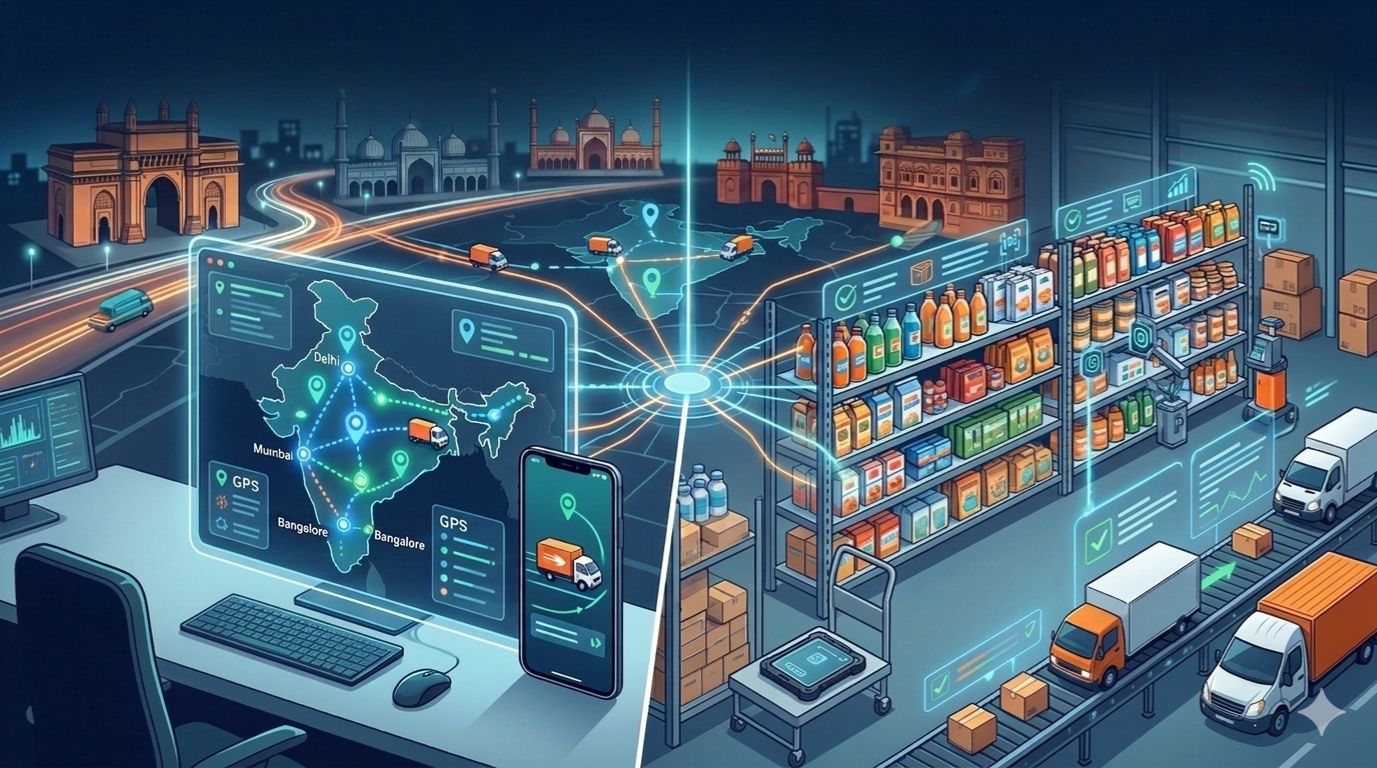
Your reps are on the road every day. But are they going to the right places?
82% of field sales reps admit to inefficient route planning during the workday. On average, that translates to 1 to 3 hours lost every single day per rep, not to a tough negotiation or a difficult outlet, but simply to the windshield.
Picture this. Fifty field sales reps hit the road every morning with no structured route, no prioritised outlet list, and no shared clarity on which stores need a visit twice a week versus once a month. By noon, two reps have criss-crossed the same street. A cluster of high-potential outlets at the edge of the territory has not seen anyone all day. One rep spent 40 minutes in traffic between two stores that were a five-minute walk from each other.
This is not a hypothetical. For many FMCG companies operating across Tier 2 and Tier 3 markets in India, this is a regular Tuesday. Multiply those wasted hours by 50 reps, five days a week, and you are looking at thousands of selling hours lost every month to poor planning, not poor effort.
The answer is not to hire more reps or upgrade vehicles. The answer is structured beat planning. And getting it right is one of the most impactful decisions a sales leadership team can make.
In FMCG distribution, the field rep is the last mile. How intelligently that last mile is planned determines whether your product sits on the shelf or gathers dust in a stockist’s warehouse.
What is beat planning in sales?
Beat planning in sales is the process of designing structured routes for field sales representatives, deciding which retail outlets each rep is responsible for, how frequently each outlet should be visited, in what sequence the rep should travel, and how much time to allocate at each stop. The pre-defined geographic area and outlet set assigned to a rep is called a beat, and it typically runs on a daily, weekly, or fortnightly cycle.
Think of it as the operating rhythm of your field force. A well-designed beat plan answers four questions for every rep, every single day:
- Where do I go? The specific outlets on today’s route
- In what order? A travel sequence that cuts idle time
- How long do I spend? Time allocated by outlet tier and sales potential
- How often do I return? Visit frequency matched to replenishment cycles and relationship depth
Sounds simple. Executing it across hundreds of reps and thousands of outlets in varied geographies is anything but.
Struggling with manual beat planning?
See how modern SFA tools help FMCG companies build data-driven beats, track adherence in real time, and give every rep a smarter route every morning.
→ Book a free demo at massistcrm.com
Why beat planning matters for FMCG field teams
The scale problem
FMCG companies in India operate in one of the world’s most complex retail environments. A mid-sized consumer goods brand might serve anywhere from 50,000 to 5 million retail touchpoints, from modern trade hypermarkets to single-shelf kirana stores in semi-urban villages.
Unlike B2B sales where a rep typically manages 20 accounts, an FMCG field rep is usually responsible for 80 to 150 outlets per beat cycle. At that scale, a 10% routing inefficiency alone adds up to thousands of wasted rep-hours every month across the organisation.
30-40%
of a rep’s day lost to travel in unplanned beats
15-25%
lift in effective outlet coverage after beat optimisation
2x
more productive calls per day with structured route planning
Coverage is not the same as productivity
There is a distinction that sales managers often miss: visiting more outlets is not the same as selling more.
A rep who rushes through 60 outlets a day without enough time to check stock levels, introduce new SKUs, or follow up on distributor claims is generating activity, not results. Beat planning is not just about coverage. It is about designing routes that give reps enough time and mental bandwidth to actually sell at each stop.
That means smart beat planning must account for:
- The actual sales potential of each outlet (not every store deserves equal attention)
- The competitive intensity in each micro-market
- Task complexity by outlet type: order taking, merchandising, scheme communication, and stock auditing each demand different time allocations
Beat planning vs. route planning: what is the difference?
These two terms are often used interchangeably, but they mean different things:
- A beat is the set of outlets a rep is responsible for within a defined territory and cycle.
- A route is the optimised travel path within that beat for a specific day, designed to minimise distance and transit time.
Beat planning defines what gets covered and how often. Route planning defines how you get there. Both need to work together. A well-designed beat with a poorly sequenced route still produces wasted travel time. A great route within a poorly designed beat still sends reps to the wrong places.
Core components of an effective beat plan
1. Territory segmentation
Before designing individual beats, the wider sales territory needs to be broken into logical geographic units, typically by town, ward, market cluster, or PIN code. Good segmentation makes each beat compact enough to cover in a day without excessive travel, and large enough to justify the rep’s time.
The core principle is geographic contiguity: outlets within a beat should be close to each other. Overlapping beats between reps is one of the most common and costly failure modes in FMCG field operations. It is also surprisingly easy to miss when beats are designed in a spreadsheet without a live map view of the territory.
2. Outlet classification and visit frequency
Not every outlet deserves the same attention. Most FMCG companies classify their trade universe into tiers based on throughput, strategic importance, or revenue contribution:
- Class A (top performers): Weekly visits, longer dwell time, dedicated shelf management and scheme execution
- Class B (mid-tier): Fortnightly visits, standard order taking and scheme updates
- Class C (lower volume): Monthly or bi-monthly visits, efficient route stops
Getting this matrix right is critical. Over-visiting low-value outlets burns rep bandwidth. Under-visiting high-potential ones means leaving revenue on the shelf, literally. The important detail here is that classifications should be driven by actual sales data, not just the outlet format. A neighbourhood kirana in the right catchment area can easily outperform a larger format store in weekly off-take.
3. Route sequencing and time allocation
Once outlets are assigned and visit frequencies locked in, the rep’s daily journey needs to be sequenced for minimum travel distance. This is where most paper-based beat plans fall apart. They define what needs to happen but ignore how to get there efficiently.
Good route sequencing accounts for real-world road constraints like one-way streets and market-day congestion, outlet opening hours (wholesale markets typically peak early in the morning), and adjacent clusters that can be batched into a single market visit. Without this, reps end up backtracking, waiting outside closed outlets, and adding unnecessary kilometres to an already demanding day.
4. Workload balancing across the field force
A beat plan is only sustainable if the workload is fairly distributed. A rep carrying 130 outlets with 60% Class A coverage will burn out. A rep managing 80 scattered Class C outlets will not hit their targets. Workload balancing is as much a people decision as a sales strategy one, and it rarely gets the attention it deserves at the planning stage.
Traditional beat planning vs. modern data-driven beat planning
For decades, beat plans were static documents. Printed Excel sheets or hand-drawn route maps that a sales manager updated once a quarter, if at all. The rep followed the same route, visited the same stores, in the same order, week after week.
That approach had operational simplicity. But it came with serious blind spots:
- No mechanism to respond to new outlet openings or closures
- No adjustment for seasonal demand shifts, whether a summer SKU push or a festive season volume spike
- No visibility into whether reps were actually following planned routes
- No data on how much time was spent at outlets versus lost in transit
The shift happening now is significant. Leading FMCG companies are moving toward dynamic, data-driven beat planning tied to real-time sales data, outlet performance scores, and GPS-enabled field tracking. The beat plan is no longer a static calendar. It is a living system that adjusts as the market changes.
Modern sales force automation (SFA) platforms make this possible. They give managers a live view of rep activity, outlet-level performance, beat plan adherence, and time-at-outlet data, all from a single dashboard. When that data feeds back into the planning cycle, the beat plan stops being a document and starts being a decision-making engine.
The underlying logic is straightforward: if your sales data updates daily, your field routing strategy should be responsive to it, not frozen in a spreadsheet from three months ago.
How to build a beat plan: a step-by-step framework
Whether you are starting fresh in a new territory or restructuring an existing one, this framework gives you a solid starting point.
- Map your outlet universe. Build a comprehensive list of all outlets, existing and potential, within the territory. Include geo-coordinates wherever possible. Without this, you are designing routes in the dark.
- Classify outlets by tier. Use historical sales data, average order size, and strategic importance to assign each outlet to a coverage tier. Avoid relying solely on outlet format or size.
- Set visit frequency by tier. Establish standard visit norms per tier. These become your baseline scheduling rules and feed directly into how many working days each beat cycle requires.
- Segment the territory into beats. Group outlets into compact geographic clusters. Each cluster becomes a beat. Aim for contiguous coverage with no overlap between reps.
- Assign beats to reps. Match beats to reps based on workload equity, local market knowledge, and travel efficiency. Check the tier mix so no single rep is disproportionately overloaded with high-effort Class A outlets.
- Sequence daily routes. Within each beat, define the optimal travel order for each day. Minimise backtracking. Account for market-day patterns, outlet opening hours, and adjacent clusters.
- Review on a structured cadence. Set a quarterly review cycle to realign beats as new outlets open, reps change, territories expand, or outlet performance shifts significantly. Do not wait for something to break before you revise.
Common mistakes that derail beat plans
Even well-designed beat plans fail in the field. These are the failure modes that come up most often:
- Over-relying on historical routes. Beats inherited from a previous rep or copied from a legacy plan often reflect outdated market realities. The trade universe changes faster than most planning cycles.
- Ignoring outlet-level sales data. Assigning visit frequency based only on outlet format rather than actual throughput leads to badly allocated rep time. A big-format store is not always the most productive stop.
- Missing market-day patterns. In many Indian markets, different localities have specific high-traffic days. A rep visiting a weekly bazaar on an off-day wastes a prime selling window that only comes around once a week.
- No adherence tracking. A beat plan that lives on paper but is never monitored in the field is just a document. Without real-time GPS tracking and adherence data, you cannot tell a well-executed plan from a theoretical one. SFA tools with geo-fencing and live location updates close this gap entirely.
- Treating beats as permanent. Markets evolve. New housing clusters emerge, industrial zones grow, competitor activity shifts channel dynamics. Beat plans need structured review cycles, not just emergency edits when things go obviously wrong.
Key metrics to measure beat plan performance
What gets measured gets managed. These are the KPIs that give sales managers genuine visibility into how well their beat plans are working in practice:
- Productive Calls Per Day (PCPD) – The number of successful sales interactions per rep per day. A rising PCPD after beat restructuring is usually the clearest early signal of improved efficiency. If PCPD drops after a change, that is a signal to investigate route sequencing and outlet density.
- Lines Per Call (LPC) – The average number of distinct SKUs ordered per outlet visit. Low LPC often signals that reps do not have enough dwell time at each outlet. That is a beat design problem, not a rep performance problem, and it needs to be fixed at the planning stage.
- Beat Plan Adherence (BPA) – The percentage of planned outlet visits that actually happen. A BPA consistently below 85% means either the plan is unrealistic or accountability mechanisms are weak. With mobile SFA apps that record geo-tagged visit logs, managers can see adherence in real time rather than waiting for end-of-day reports.
- Outlet Coverage Rate – Of all outlets in the territory, what percentage received at least one visit last month? Low numbers mean parts of the market are invisible to your field force, and that usually means a competitor is filling the gap.
- New Outlet Addition Rate – How quickly newly opened outlets get added to the beat. A slow addition rate means untapped revenue is sitting unaddressed, sometimes for months before anyone notices.
- Travel-to-Selling Time Ratio – The share of a rep’s working day spent in transit versus actually at outlets. A well-designed beat, combined with intelligent route sequencing, keeps this ratio below 30 to 35%. Anything above that is a planning problem.
Beat performance metrics are a mirror. If your team’s LPC is dropping while PCPD is climbing, your reps are rushing through calls rather than working their routes. The numbers always tell a story, and the beat plan is usually part of it.
How technology is changing beat planning for FMCG teams
The gap between a beat plan on paper and what actually happens on the ground used to be invisible. Managers had no reliable way to know if reps were following planned routes, spending adequate time at each outlet, or covering the right stores on the right days. They would find out at the end of the month when the numbers did not add up.
Modern SFA platforms have changed this completely. Here is what a well-implemented SFA tool now makes possible for FMCG field teams:
Real-time GPS tracking and geo-fenced attendance
Reps check in at outlets using GPS-verified or geo-fenced attendance. Managers can see, in real time, whether a rep has visited the planned outlets, how long they stayed, and whether they are on track for the day’s beat. Facial recognition attendance adds another layer of verification for teams spread across large or remote territories.
Offline-first mobile access
Many Tier 2 and Tier 3 markets in India have patchy internet connectivity. A good field app works fully offline, allowing reps to log visits, capture orders, record stock levels, and update outlet data without a network connection. Everything syncs automatically when connectivity is restored. This means no lost data and no excuse for skipping outlet visits in low-coverage areas.
Live beat plan adherence dashboards
Sales managers get a live view of BPA across the entire field force, broken down by rep, beat, and outlet tier. Instead of finding out that adherence has slipped at the end of the month, managers can spot gaps in real time and correct them before they cost revenue.
Outlet performance data feeding back into planning
When order history, stock levels, and visit outcomes are captured digitally at every outlet, that data feeds directly into the next planning cycle. Outlets can be reclassified by actual performance rather than assumptions. New outlets can be onboarded into the beat as soon as they are identified. Dormant outlets can be flagged for targeted intervention. The beat plan stops being a static calendar and becomes a continuously improving system.
Distributor management integration
In a well-integrated setup, the field rep’s outlet-level activity, order placement, and stock visibility are connected to the distributor management system. This means stockists see demand signals from the field in real time, distributors can anticipate replenishment requirements, and secondary sales data becomes visible all the way up the chain. The last mile connects to the rest of the supply chain.
Beat planning is an operational capability, not a one-time task
Beat planning is not a quarterly box-ticking exercise. It is a core operational capability. And like most capabilities, it compounds. Teams that invest in structured, data-driven beat design consistently outperform those relying on rep intuition alone, not because their reps are better, but because the system gives every rep the best possible conditions to sell.
The shift from static, paper-based beats to dynamic, technology-enabled ones changes what managers can see, how quickly they can respond to market changes, and how fairly workloads are distributed across the field force. When GPS tracking, real-time sales data, and outlet performance scores feed back into the planning process, beat planning becomes a continuous discipline rather than an annual chore.
The best FMCG field organisations share one trait: they treat the beat plan as a strategic asset, not an administrative formality. They review it with data, update it with discipline, and hold their teams accountable to executing it.
Get that right, and you have not just optimised a route. You have built the foundation for scalable, predictable revenue growth, one outlet visit at a time.
Key takeaways
- Beat planning defines who visits which outlets, how often, and in what order. Route planning defines how to get there efficiently. Both matter.
- Classify outlets by actual sales data, not just outlet format or size.
- Visit frequency should match each outlet’s revenue contribution, not a default cycle applied uniformly across the territory.
- A beat plan without adherence tracking is just a document. Use GPS-verified tools to close the gap between plan and execution.
- Review beats on a structured quarterly cadence, not only when something breaks.
- Modern SFA tools connect beat planning, route optimisation, adherence tracking, and outlet performance data into one system that improves itself over time.
- The field rep’s time is your most finite resource. Plan it like it costs what it actually costs.
Frequently asked questions about beat planning
- What is a beat in FMCG sales?
A beat in FMCG sales is a pre-defined geographic area and set of retail outlets assigned to a field sales representative, which they are responsible for visiting within a fixed cycle, usually daily, weekly, or fortnightly.
- What is the difference between a beat plan and a route plan?
A beat plan defines which outlets a rep covers and how often. A route plan defines the optimised travel sequence within a beat for a specific day. Beat planning is the strategic layer; route planning is the operational one.
- How often should FMCG beat plans be reviewed?
Best practice is a quarterly review cadence, with ad-hoc updates as new outlets open or significant shifts in outlet performance are identified. Static, annual reviews are a key reason many beat plans become outdated.
- What is beat plan adherence (BPA)?
Beat plan adherence measures the percentage of planned outlet visits that a rep actually completes within a cycle. A BPA below 85% consistently is a signal that the plan may be unrealistic, or that on-ground accountability mechanisms need strengthening.
- How does SFA software improve beat planning?
SFA (Sales Force Automation) software provides GPS-verified attendance, real-time adherence tracking, outlet performance data, and live manager dashboards. This closes the gap between what is planned on paper and what actually happens in the field, and feeds performance data back into the next planning cycle.
Ready to move beyond spreadsheet-based beat planning?
See how FMCG field teams use SFA tools to build smarter beats, track every outlet visit in real time, reduce travel-to-selling time, and connect field execution directly to distributor management. Most teams go live within a week.
Request a Free Demo

 Beauty Advisor Application/Promoters App