How Digital Transformation Improves Building Materials Efficiency by 30%
The building materials industry is undergoing a major digital transformation, driven by the need to improve supply chain efficiency, sales performance, and customer engagement. According to McKinsey, companies adopting digital...
The building materials industry is undergoing a major digital transformation, driven by the need to improve supply chain efficiency, sales performance, and customer engagement. According to McKinsey, companies adopting digital technologies in construction supply chains can increase productivity by up to 30%. This transformation affects manufacturers, distributors, and retailers in segments like cement, steel, tiles, and paints etc.
Digital transformation in building materials means reengineering operations and distribution channels with advanced technologies to meet rising market demands, optimize multi-tier supply chains, and achieve higher profitability.
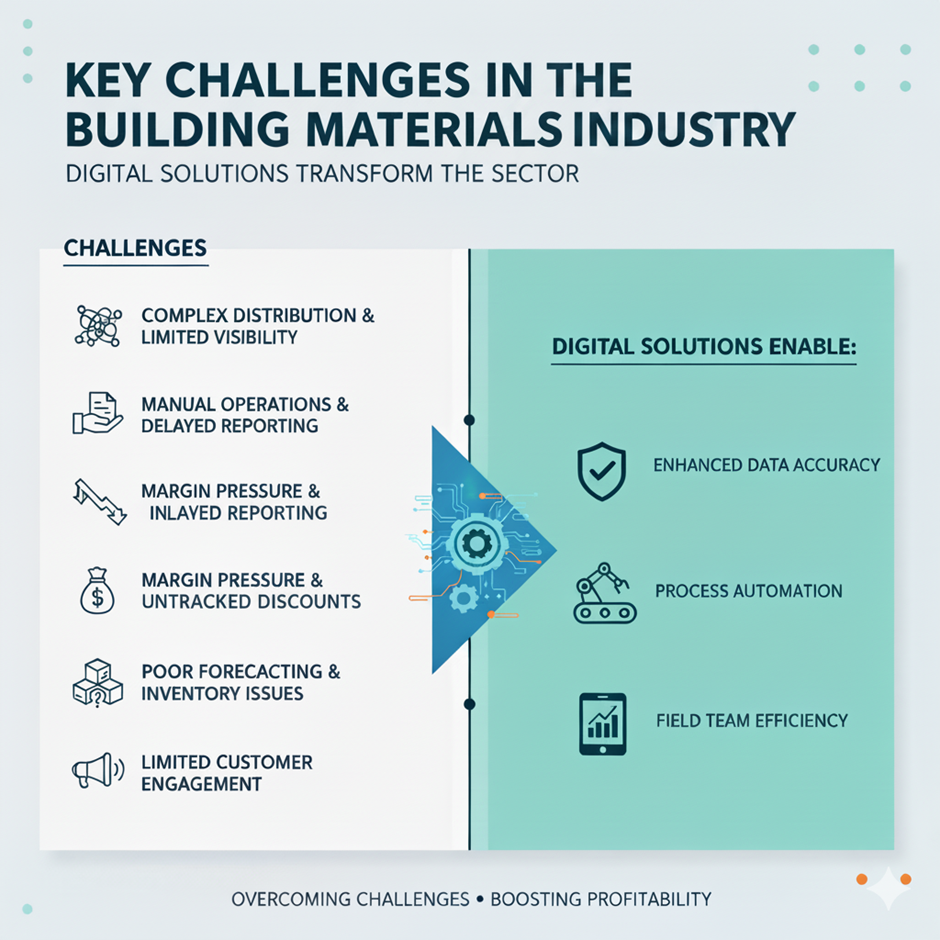
Key Challenges in the Building Materials Industry
The building materials sector faces multiple challenges that digital solutions address:
Complex and multi-tiered distribution networks with limited real-time sales visibility.
Manual, paper-based sales force operations leading to delayed and inaccurate reporting.
Margin pressure due to intense competition and untracked discount leakages.
Ineffective demand forecasting and inventory management with frequent stockouts and overstocks.
Limited customer engagement and poor sales channel communication.
Digital transformation enables overcoming these challenges by enhancing data accuracy, process automation, and field team efficiency.
How Digital Transformation Drives Industry Change
Supply Chain Digitization–
With digitization of supply chains, real-time tracking of the inventory becomes possible, demand forecasting accuracy is enhanced, and logistics are optimized in the entire chain from manufacturers to warehouses and distributors. Because of this digital integration, it is possible to reduce stockouts, minimize holding costs, and improve delivery reliability, which is very important in construction projects with a tight schedule.
Mobile-enabled SFA solutions allow sales teams to perform order booking, attendance tracking, and route planning (PJP) while on the move. The availability of real-time sales data and the possibility of monitoring activities help to increase sales productivity, decrease the occurrence of manual errors, and facilitate agile management of the field.
The support of advanced DMS platforms extends to gaining complete visibility of secondary sales, the management of dynamic schemes and pricing, and automated credit control within the multi-level dealership networks, all done with a single click. Thus, leakage of revenue is minimized, cash flow is improved, and the collaboration with dealers is deepened.
Digital Customer Engagement–
Digital customer engagement channels in the form of dealer portals and highly personalized mobile apps offer unlimited access to customers for placing and tracking orders. The integration of CRM into the system makes it possible to send targeted promotions and loyalty programs, thus improving the satisfaction and retention of customers.
Benefits of Digital Transformation in Building Materials
The automating of sales and distribution processes has brought about improved operational efficiency.
The use of data in inventory planning leads to cost reduction and ensures the availability of the product.
Through enhanced dealer and retailer relationships, trust in the channel and responsiveness are deepened.
By extending their reach to Tier-2 and rural markets, the company raises the potential of its revenue streams.
The company gains a competitive advantage if it is among the first to implement digital tools and has real-time access to the market.
Strategic Importance of SFA and DMS
SFA and DMS solutions are critical digital enablers in the building materials industry:
Manage attendance, route plans, and order capture for construction-site sales teams.
Align inventory with seasonal demand fluctuations inherent to building materials.
Automate scheme rollouts and dealer incentive management at scale.
Streamline expense claims and administrative workflows for field sales staff.
Track contractor and dealer events to support product launches and market education.
Integrated SFA-DMS platforms create a unified data ecosystem, improving sales execution and strategic decision-making.
Future Trends in Building Materials Digitalization
Emerging technologies set to accelerate transformation include:
Artificial Intelligence (AI) for predictive demand forecasting and risk analysis.
Internet of Things (IoT) to enable smart warehouse inventory monitoring.
Advanced analytics and geo-intelligence for optimized sales territory management.
Collaborative digital platforms involving contractors, architects, and engineers for enhanced project coordination.
Early investment in these technologies will future-proof companies, improve efficiency, and unlock new business models.
Frequently Asked Questions (FAQs)
1. What changes does digital transformation bring to the building materials industry?
Where digital transformation in the building materials industry culminates in the use of advanced technologies such as AI, IoT, cloud computing, and automation that would revolutionize the production, supply chain, sales, and distribution processes making them more efficient, data accurate, and customer-friendly.
2. How do the implementations of digital transformation affect the operations of building materials manufacturers and distributors?
The processes become simplified through digital technology use that allows the supply chain to be digitized, and manufacturers to have real-time access to inventory and sales data, better demand forecasting, less money lost through leakage, stronger relationships between multi-tier distributors, and avenues to access the growing Tier-2 and rural markets.
3. What are the main contributions of Sales Force Automation (SFA) to the building materials sector?
SFA facilitates mobile order booking, along with automated attendance tracking, and route planning, thus resulting in sales force productivity, a reduction in the number of manual errors, and the availability of real-time sales activity insights to managers, thereby being vital for field sales teams in building materials distribution.
4. In which ways can a Distributor Management System (DMS) help supply chain management in the building materials sector?
Some of the ways DMS can help are by providing end-to-end visibility across distributors and dealers, facilitating scheme and pricing management, automating credit and payment processes, reducing stockouts and revenue leakage, and enhancing distributor engagement through transparent, data-driven collaboration.
5. What future possibilities are created by the emergence of the new technologies in the field of building materials industry digitalization?
Artificial Intelligence (AI) is used for predictive demand forecasting, Internet of Things (IoT) for smart inventory tracking, advanced analytics for sales territory optimization, and collaborative digital platforms, such as those involving contractors, architects, and engineers, are some of the key technologies that are driving the future of this industry.
6. What are the reasons for digital customer engagement to be very necessary for building materials companies?
One major digital engagement measure, which involves dealer portals and personalized mobile apps, enables 24/7 order placement and tracking, targeted promotions, and loyalty programs, thereby enhancing dealer satisfaction, increasing customer loyalty, and resulting in higher sales conversion rates.
7. In what ways can the digital transformation facilitate the entry of building material companies to rural and Tier-2 markets?
The use of digital order management, remote sales tracking, and data-driven market analysis not only enables companies to efficiently manage complex distribution networks but also to have an extended reach into the underserved and high-growth rural as well as Tier-2 urban regions.
Conclusion
Digital transformation is revolutionizing the building materials industry by delivering measurable efficiency gains, operational transparency, and enhanced channel engagement. Sales Force Automation and Distributor Management Systems are foundational pillars powering this change, enabling businesses to streamline complex supply chains and empower field teams. Those who embrace these digital solutions today gain a decisive advantage in an increasingly competitive and demanding market.

 Beauty Advisor Application/Promoters App