The sales environment for Consumer Packaged Goods (CPG) has never been straightforward. However, as we approach 2026, it has grown extremely harsh.
Recent industry analysis indicates that fragmented retail landscapes and shifting consumer loyalty have made real-time data a survival requirement rather than a luxury. In fact, modern field teams now face a reality where nearly 70% of purchasing decisions are made at the shelf, yet out-of-stock rates continue to plague the sector due to disconnected supply chains.
Demand patterns tend to change from one day to another. Retailers want faster replenishment. Distributors function with very small margins. Field sales teams are continuously being given more outlets to cover, pushing the right SKUs, and executing trade schemes perfectly, usually with little visibility and inaccurate data.
In such a scenario, a basic sales app is simply not sufficient.
What industry players require today is a field force execution engine that brings together people, processes, distributors, and data simultaneously. This handbook unveils the necessary features of a sector-specific sales app that really brings success to the ground in 2026, going by the work norms of modern field teams.
Why FMCG Sales Apps Need to Change in 2026
A few years back, simply digitizing order capture was considered a success. Now, that is just a basic requirement.
Besides, FMCG sales leaders are facing:
- Secondary sales data fragmentation: Uncoordinated pieces of information that hinder scaling operations.
- Rise of distributor complexity: Managing more components with less margin of error.
- Greater demands: Trade marketing and finance teams now require immediate, detailed proofs of performance.
- The quick commerce boom: Local demand has become so intense that stockouts are seen and felt as never before.
- The “Execution Gap”: There is now a higher level of pressure to demonstrate, with facts, the effectiveness of every scheme, route and beat plan.
Visibility without action is simply a waste of time. And carrying out actions without intelligence is a costly affair. It is for these reasons that modern FMCG sales applications should not only give static reports but also be field decision tools.
What Characterizes a Contemporary FMCG Sales App?
By 2026, a sales app will be far from being just a tool for sales reps. It has become a collaborative environment utilized by:
- Sales representatives on the ground who can precisely plan and execute their day.
- Area and regional managers who can provide on, the, spot coaching based on the latest data.
- Distributors who can synchronize their stocks to market needs.
- Sales operations and leadership that can actively direct the brand strategy.
The aim is straightforward: sell better, not just more. A modern FMCG sales app facilitates real-time secondary sales visibility, quicker decisions in the field, and higher beat productivity. We will examine the features that allow this.
Core FMCG Sales App Features (Non-Negotiable)
-
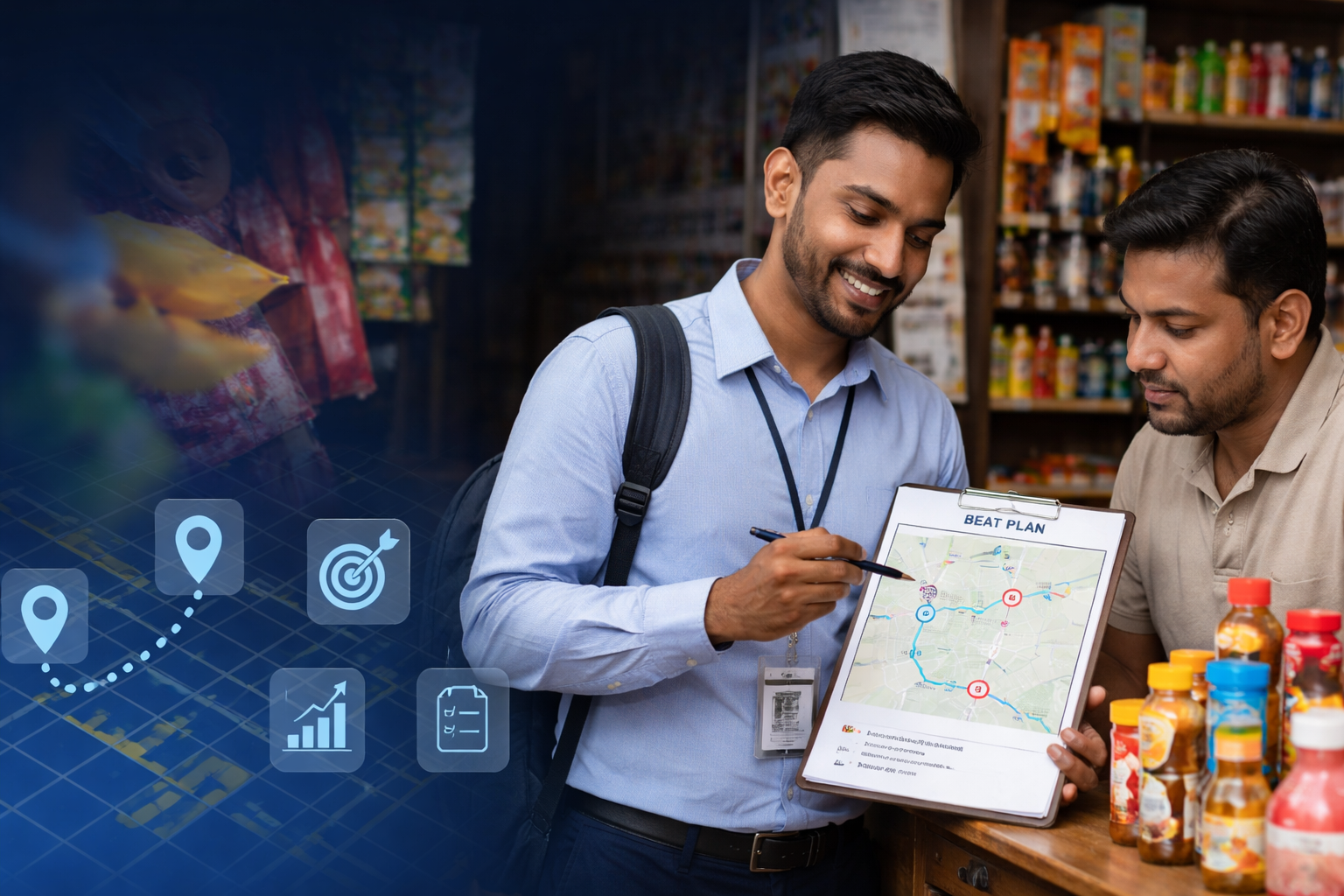
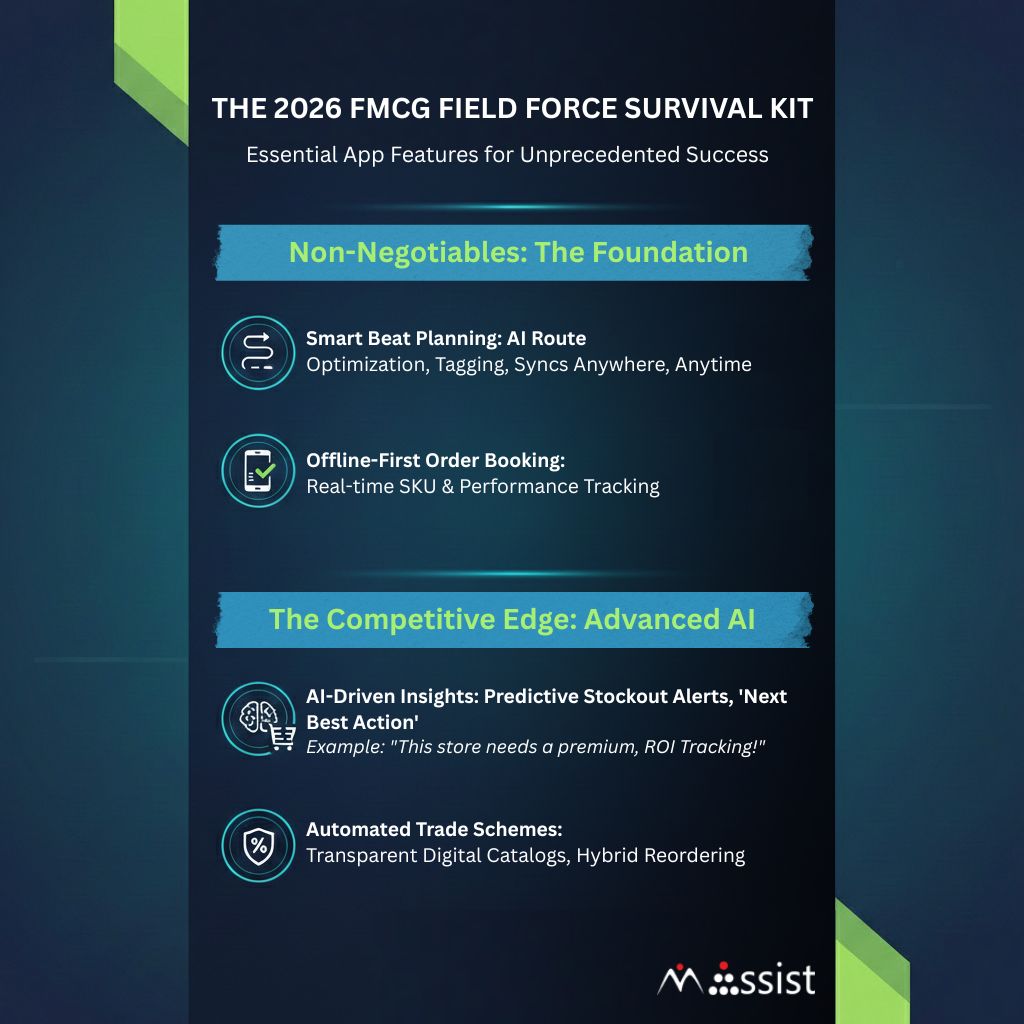
Static beat plans cannot stand real, world conditions. A powerful FMCG sales app implements an intelligent beat plan by using historical sales data, outlet potential, and visit frequency.
Besides, in 2026 that means:
- Dynamic Route Optimization: Incorporating distance, time, and traffic changes in real time.
- Priority Tagging: Automatically reschedules priority stores or urgent stock needs.
- Adherence Tracking: Getting immediate visibility of the missed, delayed, or skipped visits. More productive days, better outlet coverage, and lower operational costs are the results.
-
Real-Time Order Management (Built for the Field)
Order booking must continue to operate even in the case of network failures. A capable sales app provides the following:
- Offline, First Architecture: Collect orders at any location and sync them automatically when the network is back.
- Live Inventory Sync: The distributor stock levels integration to help eliminate “phantom orders.”
- Error Prevention: During the order placement, pricing, schemes, and credit limits are automatically checked. This keeps fulfillment running smoothly and your retailers happy.
-
True Secondary Sales Visibility
Many FMCG brands are still struggling here. Leaders are compelled to base their decisions on lagging reports when they have no secondary sales data in real time. A modern sales app closes this gap by giving:
- SKU, Level Visibility: Monitoring flow from the distributor to the retailer shelf.
- Performance Tracking: Data for the week and outlet at your fingertips.
- Early Warning Systems: Indications of falling sales before it is too late to meet quarterly targets.
Advanced Features That Drive Competitive Advantage
-
AI, Driven Sales Insights & Recommendations
AI won’t be a novelty but rather a necessity in 2026. The cutting-edge sales applications facilitate the following features:
- Predictive Stockout Alerts: Identifying that a retailer will run out of a top-selling product even before the store realizes it.
- “Next Best Action”: Suggestions for sales representatives within the app (e.g., “This store is due for a trial of a premium SKU”). The system doesn’t ask the reps to interpret the data, but instead, it leads them to make better decisions in real time.
-
Trade Promotion & Scheme Management
Trade schemes are great leverage, but they come at a high cost.
A good FMCG sales app can help:
- Handing out the application of schemes: They become transparent and auto-apply at the point of order booking.
- ROI Tracking: Getting to know through in-depth data which schemes are being effective in sales.
- Reduce Leakage: By removing manual tallying and the confusion that causes financial discrepancies.
-
Retailer Engagement Capabilities
Retailers look for convenience. The smart FMCG brands are adopting sales apps which help them meet the needs of retailers by:
- Digital Product Catalogues: Attractive pictures of the whole product range.
- Transparency: Customers can easily get their order history and price list.
- Hybrid Reordering: Provide an option for retailers to place top-up orders by the retailers in between visits of their sales reps.
Features That Empower Sales Managers
-
Live Field Force Tracking & Productivity Metrics
Sales managers just don’t need more reports; they need an understanding of what really goes on. Here are some of the features modern apps offer:
- Geo-fenced Check-ins: This feature ensures that the sales reps have actually visited the store location.
- Visit Duration Insights: Helps to spot the reps that are spending enough time in the most potential outlets.
- Coverage vs. Plan: Real-time dashboards that demonstrate if the sales force is aligned with the day’s objectives.
-
Action-Oriented Dashboards
The top dashboards not only look good but also drive action. In 2026, they have to be:
- Role-Based: Different views tailored to reps, managers, and leadership.
- Drillable: Going down the hierarchy from the national overview to hit a specific SKU in a single region quickly and easily.
- KPI Focused: Focusing on metrics like strike rates and lines per order instead of merely “total sales.”
Compliance, Security & Scalability: Often Ignored, Always Critical
When FMCG companies keep expanding, their sales apps need to run at the same pace. Some of the main features that are required:
- Role-Based Access: Only authorized personnel should have access to sensitive distributor and pricing data.
- Audit Trails: The system should be able to provide a complete and unaltered record of orders and any changes made for financial compliance purposes.
- Deep Integration: Ensure that there are smooth “handshakes” with your ERP, DMS, and finance systems.
Technology must adapt to the real world. Here are some of the characteristics of a winning FMCG sales app:
- Mobile, First & Lightweight: Go for the devices reps most often carry.
- Low, Bandwidth Optimized: A must-have if you want to be successful in rural or developing areas.
- Intuitive: It is localized in several languages and is so well designed that it requires almost no training.
Common Mistakes FMCG Brands Still Make
Despite these advancements, many brands fall into the same traps:
- Choosing dashboards over execution (pretty charts vs. real sales movement).
- Ignoring distributor integration, leading to data silos.
- Underestimating change management and field adoption.
- Using generic CRMs not built for the unique rhythm of FMCG workflows.
Final Thoughts: Building a Future-Ready FMCG Sales Engine
The right FMCG sales app is not an IT investment; it’s a growth strategy. When field teams are guided by real-time data, when distributors are aligned, and when leaders see what’s actually happening on-ground, execution improves naturally. As competition intensifies, the brands that win will be the ones whose sales systems perform best on their toughest days.
That is the true measure of field force success in 2026.

 Beauty Advisor Application/Promoters App