Generative AI. Agentic AI. Two terms that are everywhere right now and almost always used interchangeably, even though they describe fundamentally different things.
If you lead a field sales team or run distribution for an FMCG or CPG brand, this distinction matters more than it might seem. Choosing the wrong type of AI for the problem you are trying to solve means investing time and budget in a tool that will not actually fix what is broken in your operation.
This article explains both clearly, compares them directly, and shows you exactly which one does what inside a real FMCG field sales context.
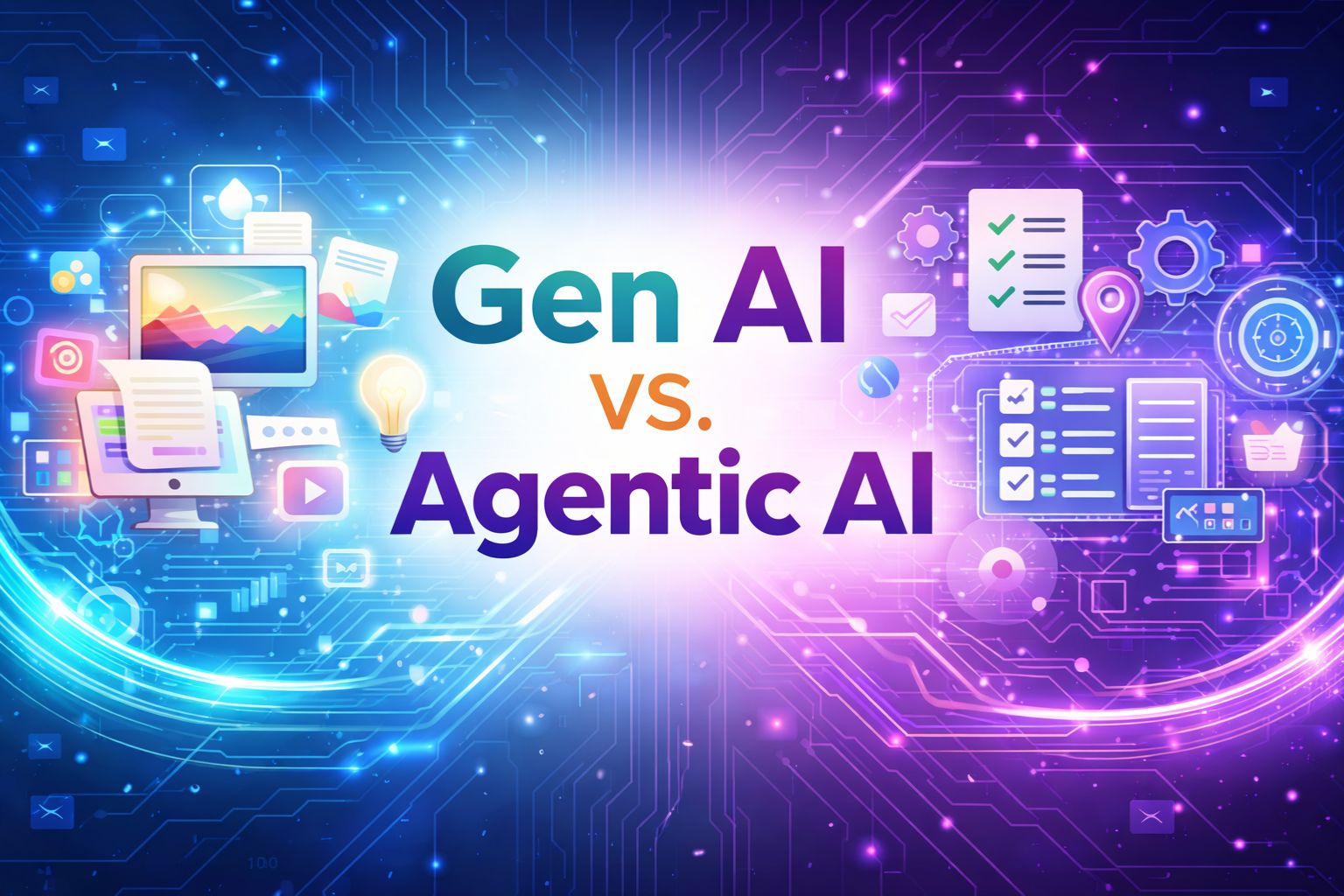
Short answer: Generative AI creates content when you ask it to. Agentic AI takes action on its own, without waiting to be asked. One gives you an output. The other delivers an outcome.
What Is Generative AI?
Generative AI is an AI system that produces new content when prompted. Give it a question or an instruction, and it generates a response: a text summary, a call report, a scheme explanation, a piece of promotional copy. It is fast, capable, and genuinely useful for content-heavy tasks.
The key thing to understand is that it is reactive. It does nothing unless a human initiates the interaction. You ask, it answers, and then it waits for the next question.
| Gen AI |
Generative AI in one sentence
A system that creates useful content on demand. Reactive by design. Requires a human prompt to produce anything. The output is a piece of content that a person then needs to act on.
|
What Is Agentic AI?
Agentic AI is an AI system that can pursue a goal independently, across multiple connected systems, with minimal human intervention. It does not wait for a prompt. It reads available data, works out what needs to happen, takes the appropriate action, checks whether it worked, and adjusts if it did not.
In a field sales context, this means an agentic AI can monitor distributor stock levels, identify which outlets need replenishment, surface the right scheme to the right rep before their visit, validate whether visits actually happened at the correct location, and flag deviations to managers in real time, all without someone having to ask it to.
Agentic
AI
Agentic AI in one sentence
A system that pursues goals autonomously, within defined boundaries. Proactive by design. Perceives data, plans steps, acts across connected systems, and learns from outcomes. The output is something that got done in the real world.
The Simplest Way to Tell Them Apart
Think of it this way. You hire a consultant to review your territory coverage. They analyse the data, write an excellent report, and hand it to you. The report tells you which outlets are underserved, what the optimal visit frequency should be, which schemes are most likely to drive uplift. It is genuinely useful.
What happens next is entirely up to you. You still need to update the beat plan, brief your reps, monitor compliance, and check whether it worked. The consultant produced intelligence. You have to produce the execution.
Now imagine instead you have an operations manager who does not just write the report. She updates the beat plan before your reps start their day. She pushes optimised routes to each rep’s app. She monitors visit compliance in real time, re-routes when an outlet is closed, and flags deviations to you the same day. She learns from this week’s data to make next week sharper.
The consultant is Generative AI. The operations manager is Agentic AI.
One brings you intelligence. The other brings you execution. The best FMCG operations are now building with both.
Gen AI vs Agentic AI: Side-by-Side Comparison
Here is a direct comparison across the six dimensions that matter most for FMCG and CPG distribution decisions.
| # |
Generative AI |
Agentic AI |
| What it does |
Produces content from a prompt: text, reports, summaries |
Takes autonomous action to complete a goal across systems |
| How it works |
You prompt it. It responds. Then it waits for the next prompt. |
It perceives data, plans steps, executes, learns, and repeats. |
| Who drives it |
Always reactive. Needs a human to start every interaction. |
Proactive. Works independently once given a goal and guardrails. |
| Output |
A piece of content for a human to review and act on. |
A completed action in the real world. |
| In FMCG sales |
Generates call reports, summaries, scheme briefings. |
Routes beats, validates claims, triggers replenishment orders. |
| Right for |
Content creation, summarisation, drafting, brainstorming. |
Beat management, order automation, visit verification, nudges. |
How Both Types of AI Show Up in FMCG Field Sales
Abstract definitions only help so much. Here is exactly how each type of AI maps to the real operational challenges in FMCG and CPG field sales and distribution.
| Use Case |
Gen AI |
Agentic AI |
| Beat Planning |
Drafts a territory coverage report for manager review |
Builds AI-optimised routes daily based on outlet velocity and DMS stock data |
| Order Management |
Helps write order summary emails to distributors |
Detects low stock, recommends orders, validates against live inventory |
| Scheme Management |
Summarises active QPS and promotional scheme structures |
Surfaces scheme eligibility per outlet at point of visit, auto-calculates benefit |
| Visit Verification |
Generates structured visit summaries from rep notes |
Geo-fences every visit, auto-flags deviations from beat plan in real time |
| Demand Signals |
Produces readable summaries of historical sell-through data |
Monitors primary-secondary gaps live, flags overstock before it compounds |
| Rep Motivation |
Drafts performance feedback messages for managers to send |
Runs live leaderboards, AI nudges, and achievement recognition automatically |
The right-hand column is what makes the difference at operational scale. Agentic AI is not producing content for someone to act on. It is doing the work itself, within boundaries your business defines, across the systems your field operation already runs on.
Do You Choose One or the Other?
Neither. The best deployments combine both.
Agentic AI systems use generative AI as one of their tools. When an AI agent surfaces a beat recommendation to a rep, explains a scheme eligibility in plain language, or generates a daily performance briefing for a sales manager, it is using a generative AI component to produce that communication. The agentic layer handles the decision and the execution. The generative layer handles the language.
Think of it as the operations director and the communications team working together. The director decides what needs to happen and coordinates the execution. The communications team makes sure every person involved understands what is happening and what to do next.
Which Type of AI Does Your Operation Need Right Now?
Use this quick guide to match your actual pain point to the right type of AI.
| If your goal is to… |
You need |
| Generate call reports and field summaries automatically |
Gen AI |
| Optimise beat routes based on outlet sales velocity |
Agentic AI |
| Create retailer-facing promotional and scheme content |
Gen AI |
| Surface scheme eligibility to each rep at the point of visit |
Agentic AI |
| Summarise territory performance in readable format |
Gen AI |
| Trigger replenishment before a stockout happens |
Agentic AI |
| Validate that visits actually happened at the right location |
Agentic AI |
| Do all of the above in one connected platform |
Both |
Frequently Asked Questions
Is Agentic AI the same as AI automation?
Not exactly. Traditional automation follows fixed rules: if X happens, do Y. Agentic AI makes decisions. It evaluates context, weighs options, and selects the best action based on current data. It can handle situations that were not explicitly pre-programmed because it reasons rather than just executes rules.
Can Agentic AI replace my field sales team?
No, and it should not try to. Agentic AI handles the execution burden that does not require human judgment: routing, visit verification, stock monitoring, scheme surfacing, order validation. Your reps are freed from the administrative overhead so they can spend their time on what only humans can do well, building retailer relationships, negotiating, and reading situations in the room.
What data does Agentic AI need to work well in FMCG distribution?
Three things matter most. Accurate outlet location data so visit verification is reliable. Live DMS inventory connectivity so order recommendations and replenishment triggers are based on actual stock, not yesterday’s figures. And verified visit history so the AI learns from real patterns rather than inflated or inaccurate beat data.
What is mAIsy and where does it fit in?
mAIsy is MAssist’s agentic AI engine, built specifically for FMCG, FMEG, and CPG distribution in India. It sits at the centre of the MAssist SFA and DMS platform and powers autonomous beat planning, geo-fenced visit verification, dynamic scheme surfacing, live order validation, and real-time sell-through monitoring. It does not generate reports and wait. It acts, within the parameters your business sets, on behalf of your field operation. Learn more at massistcrm.com.
What Agentic AI Looks Like Inside MAssist
Here is what mAIsy-powered agentic AI specifically delivers across the MAssist SFA and DMS ecosystem:
- AI-optimised beat and journey planning that builds and refreshes routes daily based on outlet sales velocity, visit history, and live DMS stock data
- Industry-first geo-fencing with intelligent visit forms that restrict visit marking to the verified outlet location and adapt data capture to the outlet context
- Dynamic Scheme Engine with per-outlet eligibility surfacing so every rep sees applicable QPS thresholds, slab discounts, and trade promotions at the moment of the sales call
- Digital order booking with live DMS stock validation preventing placement of orders against unavailable inventory and auto-applying scheme benefits in the order flow
- Primary to secondary sell-through monitoring that tracks the full three-tier distribution chain in real time and flags imbalances before they become working capital problems
- Gamification, leaderboards, and AI-driven performance nudges running automatically from each rep’s activity data, keeping teams motivated without waiting for manager intervention
A generative AI tool tells you a rep missed an outlet. An agentic AI platform flagged the deviation, re-routed the rep, and logged the exception before the end of the working day. One is content. One is execution.
See Agentic AI in Your Distribution Operation
Our platform brings agentic AI to FMCG, FMEG, and CPG field sales. Beat planning, order management, scheme execution, visit verification, and rep motivation—all autonomous, all connected, all on one platform.

 Beauty Advisor Application/Promoters App