General Trade vs. Modern Trade vs. Quick Commerce in FMCG: Key Differences & Growth Opportunities
India’s FMCG market is rapidly expanding and is estimated to be worth USD 220 billion by 2025, largely due to the different retail channels. General Trade (GT), which is basically...
India’s FMCG market is rapidly expanding and is estimated to be worth USD 220 billion by 2025, largely due to the different retail channels. General Trade (GT), which is basically kirana shops, has been the mainstay of the market whereas Modern Trade (MT) that includes supermarkets and online shopping serves urban consumers. The introduction of Quick Commerce (Qcomm) that is a fast delivery option and is headed by platforms like Zepto and Blinkit is something quite different. Nevertheless, Qcomm is not capable of substituting GT or MT because of their distinct advantages and deeply established roles. This article looks at the differences, growth possibilities, and the reason why the three channels are partners in the future of the Indian FMCG market.
A Comparative Look at Channel Strengths
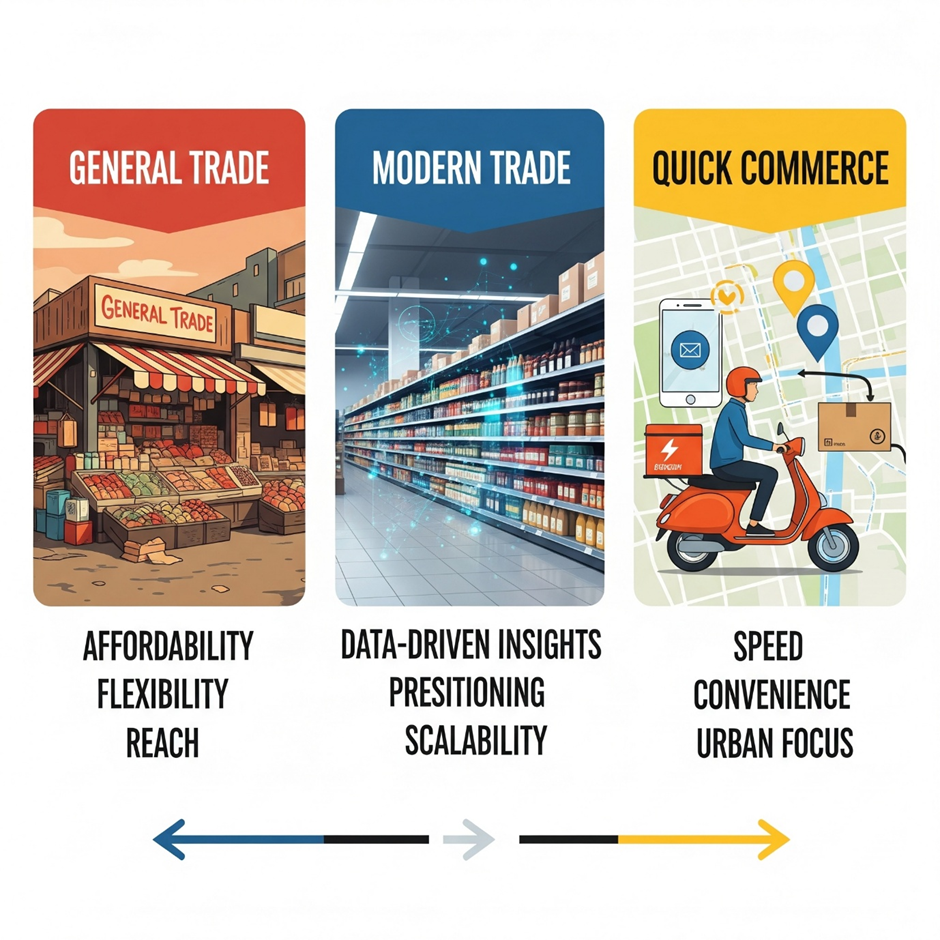
General Trade (GT)
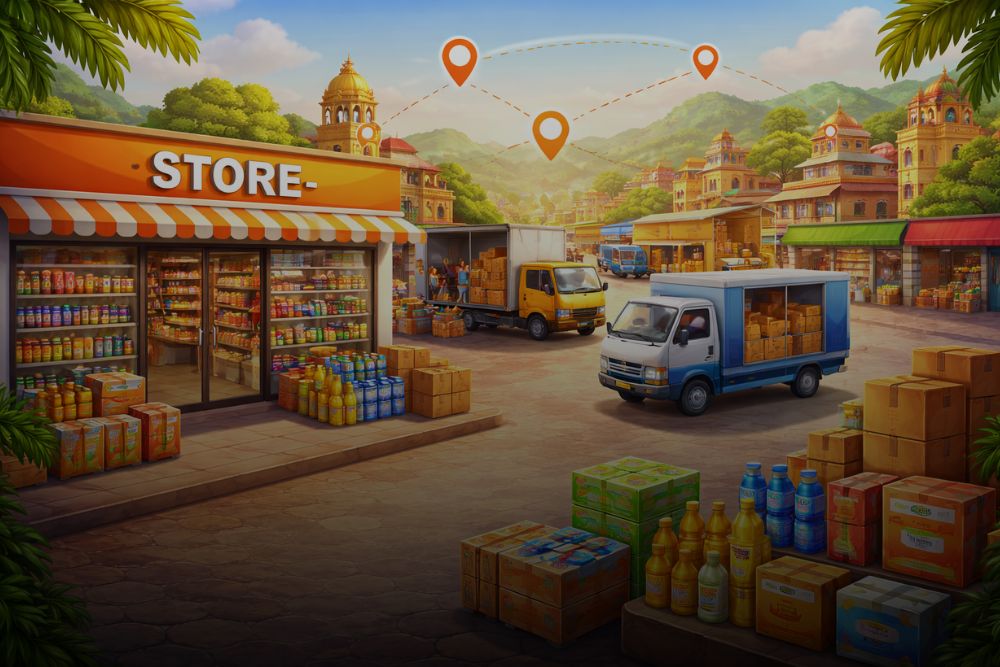
General Trade consists of local kirana shops and grocers that number in the millions, and it is still the backbone of the FMCG sector. GT’s hold on rural and semi-urban areas is based on the support of the community and the profound grasp of the local needs.
Affordability: The low operational costs enable these shops to provide competitive prices.
Flexibility: They are capable of adjusting quickly to the local demand and, therefore, can always offer the products.
Reach: They have a vast and very deep penetration of even the most remote areas that no other retail format can match.
Modern Trade (MT)
Modern Trade is composed of supermarkets, hypermarkets, and large e-commerce platforms and targets the urban consumer who demands convenience, variety, and a high-quality shopping experience. Technology and data power its operations.
Data-Driven Insights: Sophisticated analytics provide valuable consumer behavior data, thus, allowing for strategic decisions and targeted promotions.
Premium Positioning: This channel suits best for brands that want to exhibit high-margin, innovative, and branded products.
Scalability: Centralized logistics and standardized operations make it possible for efficient growth.
Quick Commerce (Qcomm)
Quick Commerce is a new frontier in urban retail with a technology-driven model of dark stores and hyper-local logistics. What distinguishes it from the rest is unmatched speed and convenience.
Speed: The ultra-fast delivery is especially suitable for instant purchases and urgent consumer needs.
Convenience: The app-based ordering process together with real-time tracking makes the user experience flawless.
Urban Focus: Quick Commerce is doing very well in metros and tier-1 cities where there is a high concentration of digital-first consumers.
Why Quick Commerce Cannot Replace GT or MT
Although Qcomm is revolutionizing urban FMCG retail, GT or MT cannot be replaced by it because of the following reasons:
General Trade’s Unmatched Reach: The millions of kirana shops of GT which are located in rural and semi-urban areas and provide Qcomm services where the infrastructure is not viable. One-to-one selling, credit facilities, and localized offerings are some of the things that make GT an unreplaceable channel for a huge consumer base.
Modern Trade’s Premium Appeal: MT is providing a greater product range, in-store experiences, and premium positioning that are beyond the reach of Qcomm’s limited inventory. Supermarkets and e-commerce platforms are there for planned purchases and bulk buying while Qcomm concentrates on small, immediate orders.
Operational Limitations: Qcomm is heavily dependent on dark stores that have limited SKUs, high operational costs, and urban-centric models and, therefore, it is a complement to rather than a substitution of GT’s volume-driven reach or MT’s data-driven scalability.
Comparing General Trade, Modern Trade, and Quick Commerce
Attribute
General Trade (GT)
Modern Trade (MT)
Quick Commerce (Qcomm)
Market Share
70–75%, rural and semi-urban focus
20–25%, urban focus
~5–10%, urban-centric, rapidly growing
Operations
Trust-based, manual, relationship-driven
Tech-enabled, standardized, automated
Hyper-local, tech-driven, instant delivery
Consumer Reach
Local, community-oriented
Urban, variety-seeking
Urban, convenience-driven
Pricing & Promotions
Flexible, credit-based, negotiation-driven
Fixed pricing, app-based discounts
Dynamic pricing, app-based offers
Supply Chain
Fragmented, local distributors
Centralized, optimized logistics
Hyper-local dark stores
Growth Rate
Stable at 8–10% annually
Accelerated at 15–20% annually
Explosive at 25–30% annually
GT drives volume through widespread reach, MT excels in premiumization and variety, and Qcomm dominates in speed and convenience. Together, they address diverse consumer needs.
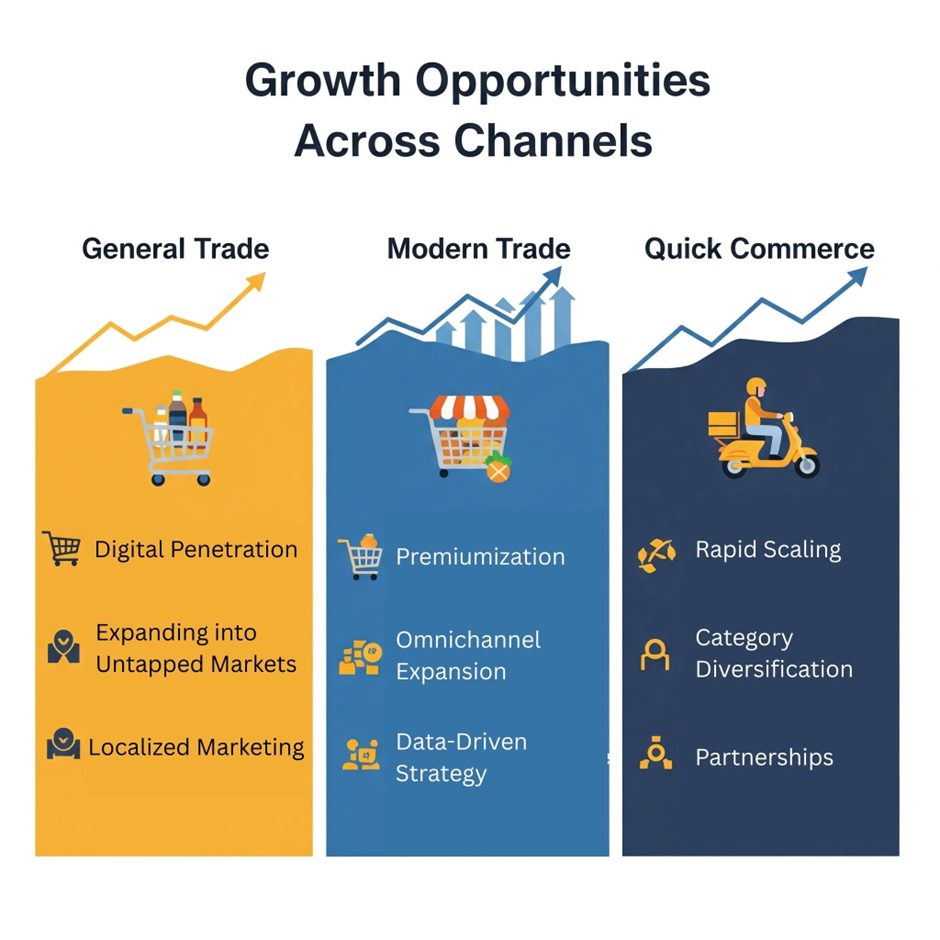
Expanding into Untapped Markets: GT is the main growth driver for the FMCG sector, with the rural population of India making up more than 65% of the total population.
Localized Marketing: Using customer relationships to promote loyalty programs.
Modern Trade
Premiumization: City consumers tend to go for premium and innovative products.
Omnichannel Expansion: Opening new markets by mixing offline and online channels.
Data-Driven Strategy: Using the latest analytics to run targeted promotions and optimize inventory.
Quick Commerce
Rapid Scaling: Growing in tier-2 cities where more people are going online.
Category Diversification: Introducing a few high-margin categories such as personal care and premium snacks.
Partnerships: Solving inventory challenges and offering exclusive launches by working together with FMCG brands.
The Future of FMCG Retail in India
The FMCG retail ecosystem is transforming into a phygital one that combines the physical reach of the network with digital smartness. Kirana shops are getting ready for UPI, barcode scanning, and inventory tools whereas MT is blending regional products to give a local flavor. Although Qcomm is a game-changer, it doesn’t replace GT and MT but rather supports them by providing a service for the instant need segment. For FMCG brands, winning means using the power of all three to get the maximum reach, efficiency, and consumer engagement.
How MAssist Drives FMCG Success Across All Channels
MAssist equips FMCG brands with state-of-the-art sales and distribution management tools to streamline General Trade (GT), Modern Trade (MT), and Quick Commerce (Qcomm), and also ensure that the channels are seamlessly integrated and scalable:
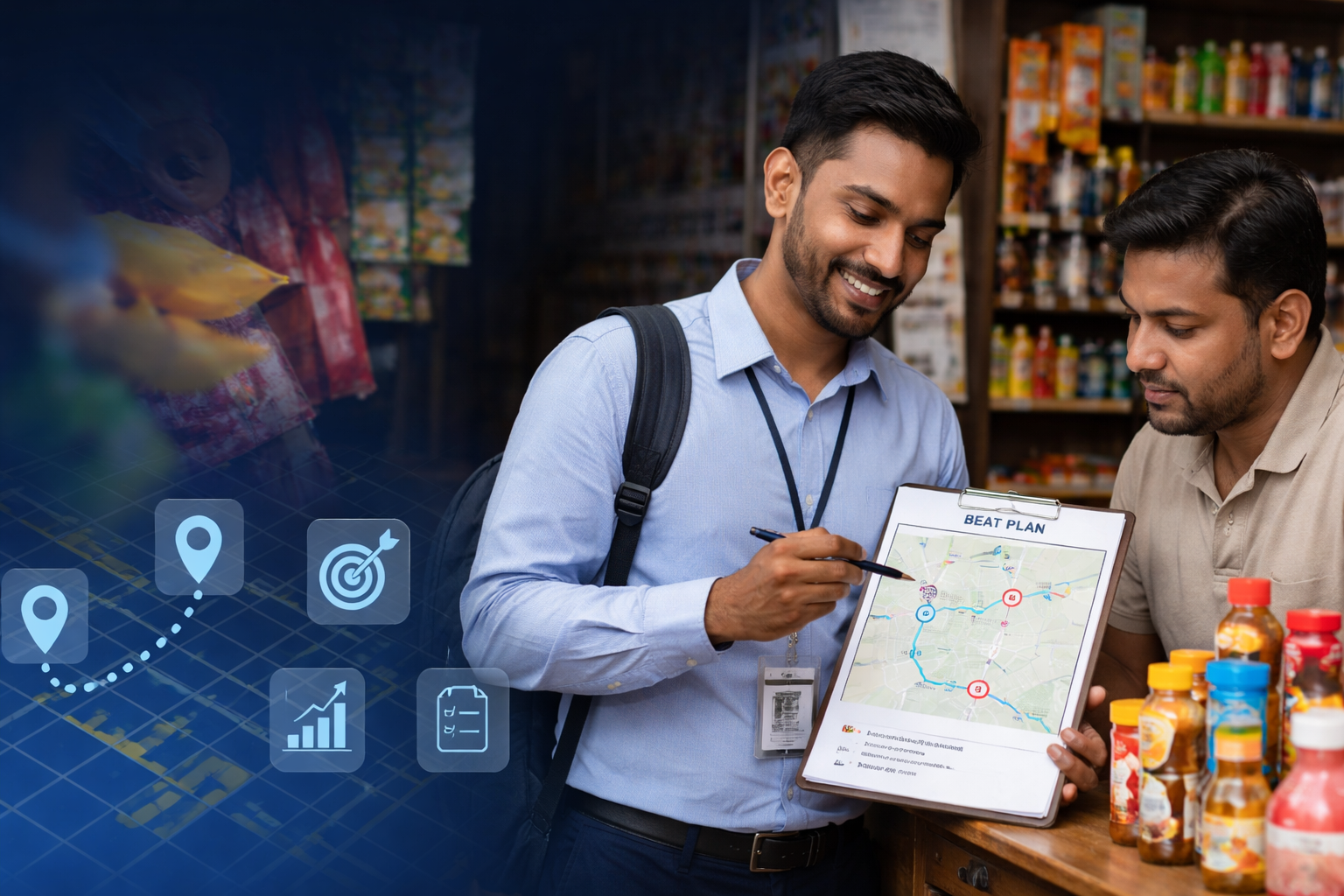
General Trade: Improves the overall operational efficiency by using a Sales Force Automation (SFA) system to keep track of sales in real-time and a Distributor Management System (DMS) for a more efficient inventory and order management process, thus, raising stock visibility and making it easier to coordinate with local distributors.
Modern Trade: Incorporates cutting-edge data analytics to consolidate the different data sources, hence, allowing more accurate targeting of urban campaigns and effective inventory distribution by following consumer trends and purchase patterns.
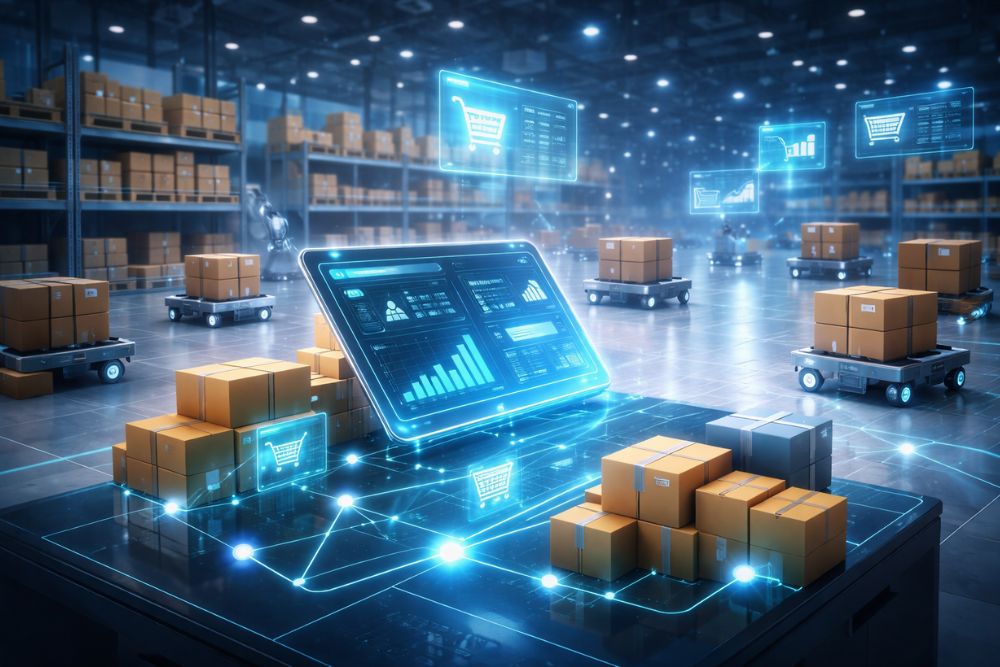
Quick Commerce: Enables quick order handling and up-to-the-minute analytics that facilitate hyper-local inventory management, therefore, allowing an efficient stock replenishment process and Qcomm’s delivery model to be in sync.
By eliminating the operational inefficiencies that exist in GT, the problem of data fragmentation in MT and the issue of high-speed demands in Qcomm, MAssist is the driving force which allows brands to not only scale dynamically but also be able to adapt to India’s FMCG market that keeps changing.
Overcoming Challenges with Intelligent Solutions
GT is characterized by common operational challengessuch as inadequate stock visibility and irregular promotions, while MT has to cope with compliance costs and data silos that fragment. The solution lies in a hybrid strategy, which combines the use of technology in both channels. Moreover, brands have the opportunity to fully utilize GT distribution during the rush demand periods, simultaneously gathering valuable MT insights to perfect urban campaigns.
Some helpful tips:
For General Trade: Educate sales personnel about the importance of creating good relationships with retailers and stress the significance of stocking small, fast-moving SKUs.
For Modern Trade: Dedicate money to attractive in-store promotion and app-based loyalty programs for interaction with urban consumers.
For Qcomm: Select the most necessary products with a short shelf life and work with platforms for exclusive releases.
FAQs –
1. What is the primary difference between General Trade and Modern Trade?
The core difference lies in organization and scale. General Trade (GT) consists of a fragmented network of small, independent retailers (e.g., kirana stores). Modern Trade (MT) consists of organized, centrally managed retail chains like hypermarkets and supermarkets.
2. Is General Trade losing relevance to Modern Trade in 2026?
Not exactly. While Modern Trade and Quick Commerce are growing, General Trade remains the backbone of FMCG distribution in many regions due to its last-mile reach in rural areas and the “high-frequency, small-ticket” buying habits of consumers.
3. How does the supply chain differ between these two channels?
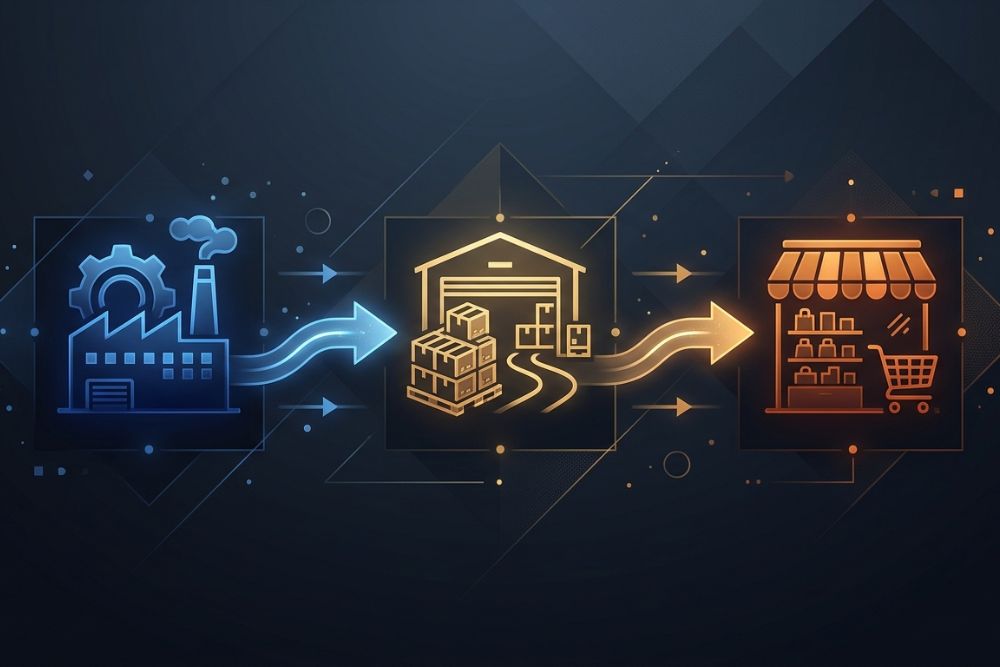
General Trade: Follows a traditional “Manufacturer → Distributor → Wholesaler → Retailer” path. It is highly dependent on a large field sales force.
Modern Trade: Often uses a more direct “Manufacturer → Distribution Center → Store” model, utilizing centralized logistics and Electronic Data Interchange (Inter-system communication) for automated replenishment.
4. What is the role of Quick Commerce in this ecosystem?
Quick Commerce (Q-Commerce) bridges the gap between the speed of a local store and the tech-driven inventory of Modern Trade. It targets the “instant gratification” segment. For brands, the challenge is gaining secondary sales visibility across these hyper-local dark stores to prevent stockouts.
5. What is “Fill Rate” and why does it matter in Modern Trade?
In Modern Trade, the Fill Rate (the percentage of a customer’s order that is met) is a critical KPI. Unlike GT, where a consumer might accept a substitute from a local shopkeeper, MT retailers often penalize brands for “out-of-stock” situations as it disrupts their automated inventory systems.
6. Which channel is more expensive for a brand to enter?
Modern Trade typically has a higher barrier to entry due to “slotting fees” (paying for shelf space) and strict margin requirements. General Trade has lower entry fees but much higher long-term operational costs due to the complexity of managing thousands of individual distributors.
Conclusion: A Complementary FMCG Ecosystem Powered by MAssist
In 2025, GT, MT, and Qcomm are interdependent pillars that sustain the Indian FMCG sector. While GT provides the widest and most authentic access, MT ensures the sector’s efficiency and maturation, and Qcomm is there for speed and ease. Thus, despite Qcomm having a huge transforming potential, the fact that it is urban-focused and has operational constraints make it impossible for it to replace GT which has wide penetration or MT which is scalable.With the help of MAssist’s cutting-edge sales and distribution technologies, FMCG companies are able to create a hybrid retail engine that is capable of driving growth which is not only sustainable but also spans across the rural heartlands, urban centers, and instant-delivery ecosystems.

 Beauty Advisor Application/Promoters App