
Quick Answer – The FMCG sales apps that hold up in 2026 combine offline-first order booking, real-time secondary sales visibility, AI-driven beat planning, automated trade scheme management, an
Quick Answer – The FMCG sales apps that hold up in 2026 combine offline-first order booking, real-time secondary sales visibility, AI-driven beat planning, automated trade scheme management, and live field tracking in one connected system. The features below are grouped by what they do for reps, for managers, and for the business, so you can benchmark any app you are evaluating against what field teams actually need on the ground.
The sales environment for Consumer Packaged Goods (CPG) has never been straightforward. However, as we approach 2026, it has grown extremely harsh.
Fragmented retail landscapes and shifting consumer loyalty have made real-time data a survival requirement rather than a luxury. In fact, modern field teams now face a reality where nearly 70% of purchasing decisions are made at the shelf, according to research from POPAI (Point of Purchase Advertising International), yet out-of-stock rates continue to plague the sector due to disconnected supply chains.
Demand patterns tend to change from one day to another. Retailers want faster replenishment. Distributors function with very small margins. Field sales teams are continuously being given more outlets to cover, pushing the right SKUs, and executing trade schemes perfectly, usually with little visibility and inaccurate data.
In such a scenario, a basic sales app is simply not sufficient.
What industry players require today is a field force execution engine that brings together people, processes, distributors, and data simultaneously. This guide is about what field reps and managers actually use day to day inside the app itself, not a breakdown of a full SFA platform’s back-end architecture. It unveils the necessary features of a sector-specific sales app that really brings success to the ground in 2026, going by the work norms of modern field teams.
A few years back, simply digitizing order capture was considered a success. Now, that is just a basic requirement.
Besides, FMCG sales leaders are facing:
Visibility without action is simply a waste of time. And carrying out actions without intelligence is a costly affair. It is for these reasons that modern FMCG sales applications should not only give static reports but also be field decision tools.
By 2026, a sales app will be far from being just a tool for sales reps. It has become a collaborative environment utilized by:
The aim is straightforward: sell better, not just more. A modern FMCG sales app facilitates real-time secondary sales visibility, quicker decisions in the field, and higher beat productivity. We will examine the features that allow this.
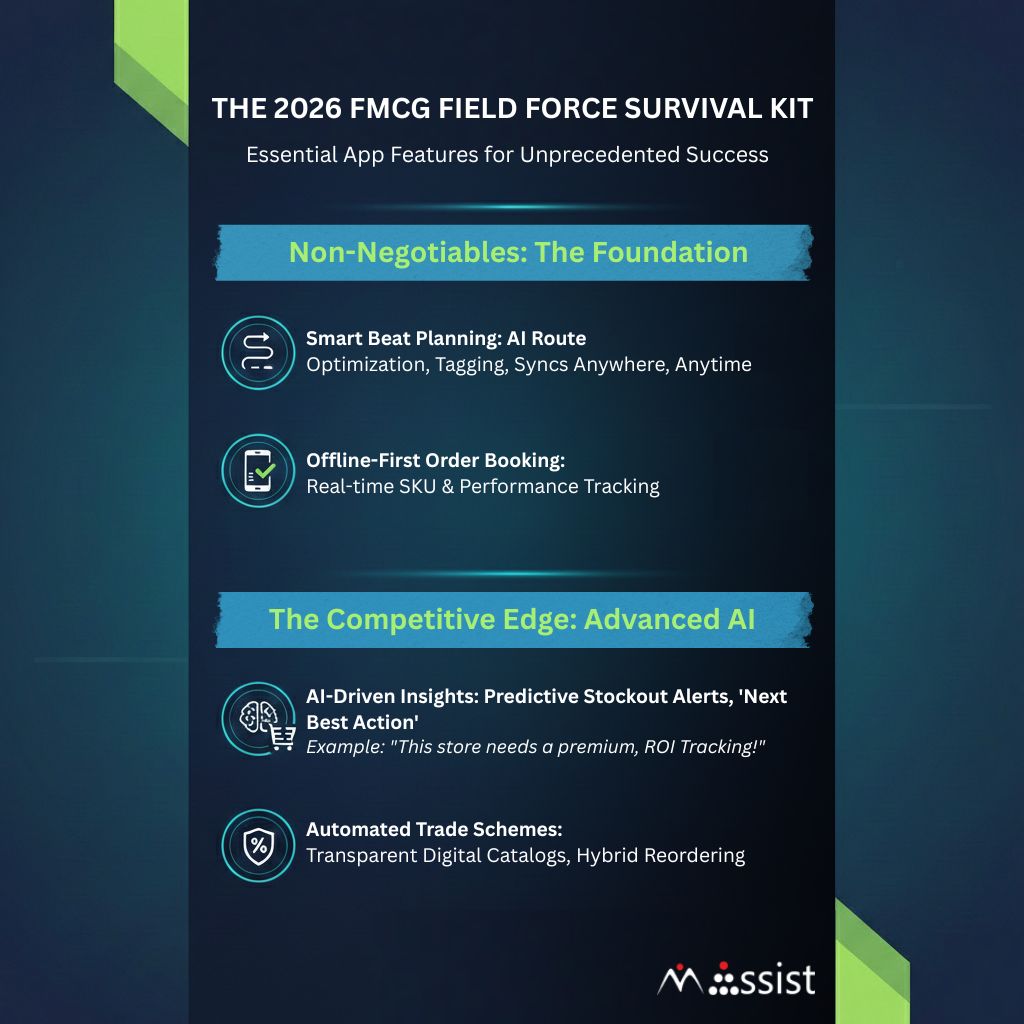
Static beat plans cannot stand real-world conditions. A powerful FMCG sales app implements an intelligent beat plan using historical sales data, outlet potential, and visit frequency, refined further through route optimization.
Besides, in 2026 that means:
Order booking must continue to operate even in the case of network failures. A capable sales app provides the following:
Many FMCG brands are still struggling here. Leaders are compelled to base their decisions on lagging reports when they have no secondary sales data in real time. A modern sales app closes this gap by giving:
AI won’t be a novelty but rather a necessity in 2026. The cutting-edge sales applications facilitate the following features:
Trade schemes are great leverage, but they come at a high cost.
A good FMCG sales app can help:
Retailers look for convenience. The smart FMCG brands are adopting sales apps which help them meet the needs of retailers by:
Sales managers just don’t need more reports; they need an understanding of what really goes on. Here are some of the features modern apps offer:
The top dashboards not only look good but also drive action. In 2026, they have to be:
However, FMCG brands are increasingly realizing that visibility alone does not guarantee execution success. Static dashboards without actionable intelligence often fail to improve on-ground sales performance. Read more in this detailed analysis on Are Dashboards Still Enough for FMCG Growth in 2026?
When FMCG companies keep expanding, their sales apps need to run at the same pace. Some of the main features that are required:
Deep Integration: Ensure that there are smooth handshakes with your ERP, Distribution Management System (DMS), and finance systems.
Technology must adapt to the real world. Here are some of the characteristics of a winning FMCG sales app:
Despite these advancements, many brands fall into the same traps:
The non-negotiables are offline-first order booking, real-time secondary sales visibility, and AI-assisted beat planning. Beyond that, trade scheme automation, live field tracking, and retailer self-service capabilities are what separate a competitive app from a merely functional one.
A general CRM is built around accounts and pipelines. A mobile sales app for FMCG field teams is built around beats, outlets, distributor stock, and order booking, with offline-first operation and geo-fenced visit verification as baseline requirements, not add-ons.
A large share of FMCG field coverage happens in low-connectivity rural and semi-urban areas. If order booking, visit forms, and beat plans stop working without signal, reps lose selling time and data quality suffers. Offline-first architecture that syncs automatically once connectivity returns is a core requirement, not a nice-to-have.
AI features like predictive stockout alerts and next-best-action recommendations remove the guesswork from a rep’s day. Instead of interpreting raw data, the rep gets a specific, actionable suggestion for each outlet, which shortens the gap between insight and execution.
Role-based access control, complete audit trails for orders and pricing changes, and deep integration with ERP, DMS, and finance systems. These are frequently overlooked during evaluation but become critical as the field force and outlet base scale.
The right FMCG sales app is not an IT investment; it’s a growth strategy. When field teams are guided by real-time data, when distributors are aligned, and when leaders see what’s actually happening on-ground, execution improves naturally. As competition intensifies, the brands that win will be the ones whose sales systems perform best on their toughest days.
That is the true measure of field force success in 2026.
Still relying on disconnected sales tools and static dashboards?
Upgrade to an AI-powered FMCG sales execution platform built for real-time field visibility, smarter order management, and distributor collaboration.
Get notified about the next update






 Salesforce Automation
 CRM & Lead Management