
General Trade (kirana-led, ~70-75% of India’s FMCG sales) leads on reach and rural penetration. Modern Trade (organised chains, ~20-25%) leads on data and premium shelf space. Quick Commerce (~5
General Trade (kirana-led, ~70-75% of India’s FMCG sales) leads on reach and rural penetration. Modern Trade (organised chains, ~20-25%) leads on data and premium shelf space. Quick Commerce (~5-10%, growing fastest) wins on speed and impulse. The three are complementary, not competing.
India’s FMCG sector is one of the most complex retail ecosystems in the world. Three distinct channels power it: General Trade (GT), Modern Trade (MT), and the fast-rising Quick Commerce (Qcomm). Each plays a different role, serves a different kind of consumer, and demands a completely different go-to-market strategy.
This guide compares all three (GT vs MT vs QC) side by side. If you specifically want the economics of quick commerce, margins, credit cycles, and how to build a hybrid GT/Qcomm strategy, our focused breakdown, Quick Commerce Impact on FMCG Distribution, covers that in depth. Here, we stay at the level every sales leader needs first: what each channel is, how they compare, and where each one is growing.
If you are an FMCG brand, a distributor, or a sales leader, understanding the real difference between general trade and modern trade, and knowing where quick commerce fits in, is no longer optional. It is the foundation of every smart distribution decision.
Before diving in, here are the abbreviations used throughout this guide:
GT — General Trade. The traditional, unorganised retail network: kirana stores, paan shops, local grocery and medical stores. Also called traditional trade in many markets.
MT — Modern Trade. The organised retail sector: supermarkets, hypermarkets, and large-format chains such as DMart, Reliance Smart, and Spencer’s.
GTMT (or GT+MT). Used collectively to refer to both channels together, especially in sales reporting, distributor management, and analytics contexts.
GT Counter / GT Store. A retail outlet within the general trade channel – typically a small, independently run shop.
GT in Sales / GT in Business. General trade as a sales channel – the set of outlets, distributors, and field-rep operations that serve the unorganised retail network.
Qcomm / Q-commerce. Quick commerce- platform-based delivery from dark stores, typically within 10 to 30 minutes.
General trade refers to the traditional, unorganized retail network in India. It includes millions of kirana stores, local grocery shops, mom-and-pop outlets, paan shops, and street-side vendors. These are independently operated businesses, usually family-run, with no centralized management.
General trade is the oldest and still the largest retail channel in India. It accounts for roughly 70 to 75 percent of all FMCG sales in the country, according to Nielsen data. In rural areas and smaller cities, that number is even higher.
What makes general trade so powerful is not just its scale. It is the trust. A kirana owner knows his customers by name. He extends credit, stocks what the neighbourhood actually needs, and operates seven days a week with low overheads. No supermarket chain can replicate that kind of local relationship.
Key characteristics of general trade:
The challenge for FMCG brands in GT is not demand. It is visibility. Brands struggle to track secondary sales, verify scheme execution, and maintain consistent stock across thousands of small outlets.
Modern trade refers to the organized retail sector. Think supermarkets, hypermarkets, large-format grocery stores, and e-commerce platforms like BigBasket. These are centrally managed, tech-enabled retail chains with standardized layouts, POS systems, and data-driven operations.
Modern trade in India is growing fast. It currently holds around 20 to 25 percent of FMCG market share, and that number is climbing at 20 percent annually, especially in metros and large Tier-1 cities.
Modern trade is where premium brands build visibility. It is where shoppers explore new categories, trial innovative products, and spend more per basket. For brands targeting urban, aspirational consumers, MT is not just a channel. It is a brand-building platform.
Key characteristics of modern trade:
The challenge in MT is that brands must meet strict compliance standards, manage data silos across store formats, and justify slotting fees with measurable ROI.
Quick commerce is the newest and fastest-growing retail channel in Indian FMCG. Led by platforms like Zepto, Blinkit, and Swiggy Instamart, Qcomm promises delivery within 10 to 30 minutes using a network of dark stores located close to residential clusters.
Qcomm currently holds around 5 to 10 percent of the urban FMCG market, but it is growing at 25 to 30 percent annually. It thrives in metros and Tier-1 cities where digital-first consumers expect instant availability.
Qcomm is not a replacement for GT or MT. It fills a different need: the urgent, top-of-mind purchase. A consumer who runs out of milk at 9 PM does not drive to a supermarket. They tap an app.
This is the question most FMCG professionals are Googling, and rightfully so. The difference between general trade and modern trade goes far beyond store size. Here is a clean breakdown:
| Attribute | General Trade (GT) | Modern Trade (MT) | Quick Commerce |
|---|---|---|---|
| Market Share (India) | 70 to 75%, rural and semi-urban focus | 20 to 25%, urban-led | 5 to 10%, urban-only, fast growing |
| Store Type | Kirana, local grocery, independent shops | Supermarkets, hypermarkets, modern chains | Dark stores, no walk-in consumers |
| Operations | Manual, relationship-driven | Tech-enabled, standardized | Hyper-local, fully automated |
| Consumer | Value-conscious, local, trust-driven | Urban, variety-seeking, brand-aware | Convenience-driven, digital-native |
| Pricing | Flexible, negotiated, credit-based | Fixed, often with app-based discounts | Dynamic pricing, promotional offers |
| Supply Chain | Fragmented, distributor-led | Centralized logistics, direct from DC | Hyper-local dark store replenishment |
| Entry Cost for Brands | Low upfront, high field ops cost | High (listing fees, margins, compliance) | Platform-dependent, often revenue share |
| Growth Rate | Stable, 8 to 10% annually | 15 to 20% annually | 25 to 30% annually |
| Data Availability | Limited, manual tracking | Rich, POS-driven analytics | Real-time demand signals |
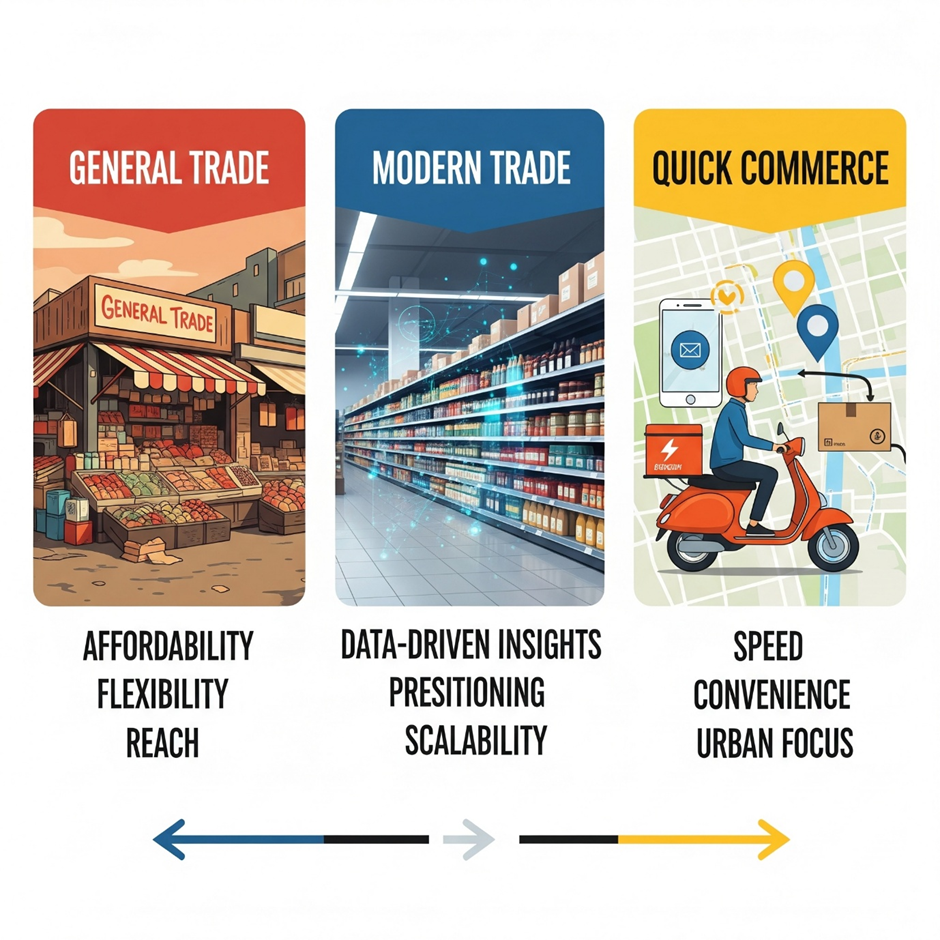
In India, general trade and traditional trade refer to the same channel — the unorganised, kirana-led retail network. The term “traditional trade” is more common in global FMCG literature and Southeast Asian markets; “general trade” is the standard term used by Indian companies, distributors, and sales teams. Both mean the same thing: small, independently operated retail outlets with manual ordering and no centralised management.
Understanding GT means understanding its distribution structure. Products do not flow directly from manufacturer to kirana. The typical GT supply chain in India has several layers:
Manufacturer → C&F Agent (Carry & Forward) → Superstockist → Redistribution Stockist (RS) / Distributor → Sub-stockist → Retailer
Each layer serves a geographic area. A superstockist covers a city or region and supplies multiple distributors. A redistribution stockist (RS) or regular distributor covers a town or cluster of pincodes. A sub-stockist covers smaller localities within a town. And the retailer – the kirana owner – is the final point before the consumer.
Field sales reps (FSRs) working for FMCG brands visit outlets on planned routes called beats. Each beat covers a set of outlets in a day. The rep takes orders, verifies stock, executes schemes, and builds relationships – the core of GT sales operations.
The complexity of this structure is exactly why numeric distribution (the percentage of relevant outlets stocking a product) and weighted distribution (share of sales-potential outlets stocking it) are the two critical GT coverage metrics for any FMCG brand.
General trade is not shrinking – it is evolving. GT sales growth in India is running at 8 to 10 percent annually in value terms, and faster in rural pockets where income growth is outpacing urban markets.
The key drivers of GT sales growth are:
For brands, the biggest GT performance lever is effective coverage – the percentage of active outlets that actually sell your brand, not just stock it. Tools that give real-time visibility into secondary sales and scheme execution are what separate the top performers from the rest.
MT distribution is structurally different from GT. Brands typically supply MT chains directly from a distribution centre (DC) to the store, bypassing the distributor layer. Replenishment is automated: when shelf stock drops below a threshold, the chain’s system generates a purchase order.
This means brands must maintain high fill rates – the percentage of an MT retailer’s order that is fulfilled completely and on time. Fill rate is not just a KPI; it is a commercial obligation. MT chains routinely penalise brands financially for stockouts, short supplies, or delayed deliveries, because a stockout at a supermarket disrupts automated replenishment systems in ways a kirana never does.
Entry into MT also involves costs that GT does not:
These costs are justified for brands with premium products and urban target consumers. MT is where category management matters – the discipline of optimising a category’s total shelf contribution (your brand plus competitors) to maximise shopper spend in that aisle.
One of the most important capabilities modern FMCG brands need is outlet-level intelligence – knowing exactly what is happening at every type of outlet, across every channel, in real time.
This means:
Getting this visibility used to require multiple disconnected tools – or, more commonly, it did not happen at all, and brands ran on stale weekly reports. Today, platforms that integrate SFA, DMS, and analytics can surface outlet-level data across GT and MT in a single view, and feed that signal into distributor replenishment decisions before stockouts reach the dark store or the shelf.
Datum Intelligence’s Q4 CY2023 data on quick commerce order share showed rapid category expansion beyond groceries into personal care and snacks – precisely the kind of signal that brands with outlet-level analytics can act on faster than their competitors.
It is tempting to assume that Qcomm will eventually eat into GT and MT. That is not what is happening on the ground.
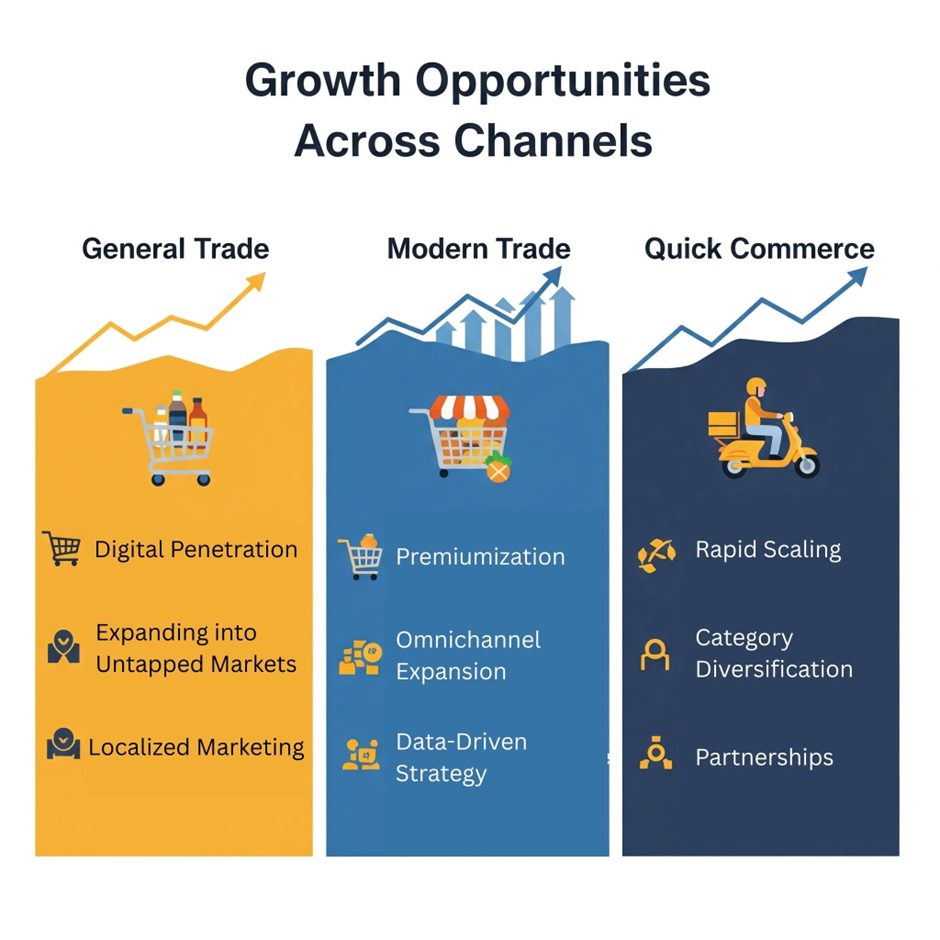
The biggest opportunity in GT is digital enablement. Tools like Sales Force Automation (SFA) and Distributor Management Systems (DMS) are transforming how brands manage this fragmented channel. Real-time order tracking, geo-verified outlet visits, and scheme compliance monitoring are now possible even for a sales rep working in a tier-3 city.
Rural India also remains underpenetrated. With more than 65 percent of India’s population still in rural areas, the volume opportunity in GT is enormous for brands willing to invest in last-mile distribution.
Urban Indian consumers are increasingly willing to pay for premium products, sustainable packaging, and new categories. MT is the right channel to capture that shift. Brands that invest in data analytics, in-store activation, and app-based loyalty programs are seeing strong returns.
Omnichannel is also becoming non-negotiable. MT players are blending physical stores with online ordering. Brands that can manage inventory across both dimensions win.
The immediate opportunity in Qcomm is category expansion beyond groceries into personal care, health supplements, and premium snacks. For the detailed SKU-segmentation and inventory-visibility playbook, see the quick commerce deep-dive.
Managing three structurally different channels with disconnected tools rarely scales. MAssist offers a unified platform – SFA, DMS, Promoter/BA App, Mobile POS, and Business Analytics – built specifically for FMCG and CPG brands operating across all three.
For General Trade: SFA gives field teams geo-verified check-ins, digital order capture, and real-time scheme tracking, with offline capability for low-connectivity areas. The DMS module connects distributors into the order flow with two-way inventory visibility and ERP integration, so managers see rep productivity and outlet coverage live instead of in end-of-day reports.
For Modern Trade: The Promoter/BA App captures tertiary sales data and verifies shelf compliance in real time, synced with SFA and DMS. Business Analytics consolidates secondary sales across MT chains to drive fill-rate management and reduce out-of-stock incidents.
For Quick Commerce: MAssist doesn’t offer native Qcomm platform integration, but its demand analytics help brands spot fast-moving SKUs and adjust distributor-side stock before a shortfall reaches the platform.
The core advantage: one operational picture across GT, MT, and Qcomm; instead of guessing whether a GT scheme is running correctly while separately chasing an MT fill-rate issue.
General trade consists of small, independent retailers like kirana stores operating on trust, relationships, and manual processes. Modern trade consists of organised chains like supermarkets (DMart, Reliance Smart, Spencer’s) that use centralised management, technology, and data-driven operations.
GT stands for General Trade. In FMCG, GT refers to the traditional, unorganised retail network – kirana stores, local grocery shops, paan shops, and independent outlets. A GT counter or GT store is any outlet within this channel. GTMT refers to General Trade and Modern Trade together.
Yes. In India, general trade and traditional trade refer to the same channel – the unorganised, kirana-led retail network. “Traditional trade” is the term used more widely in global and Southeast Asian FMCG; “general trade” is the standard Indian term.
Not yet. General trade still accounts for 70 to 75 percent of FMCG sales in India and remains dominant in rural and semi-urban markets. MT is growing faster, but GT’s last-mile reach and credit relationships keep it essential for most FMCG brands.
In GT, products move through a manufacturer → C&F agent → superstockist → distributor → sub-stockist → retailer chain, with heavy dependence on field sales reps. In MT, brands often supply directly from a distribution centre to the store, with automated replenishment through centralised logistics systems.
Qcomm (Blinkit, Zepto, Swiggy Instamart) serves the instant-need segment – orders placed when a consumer needs something right now rather than planning ahead. It complements GT and MT without replacing them, as its dark store model is limited to urban areas and a narrower product range.
Fill rate is the percentage of a retailer’s order that is fulfilled completely and on time. In MT, brands are often penalised financially for stockouts because they disrupt automated replenishment systems. Maintaining a high fill rate is one of the most important KPIs for any brand operating in modern trade.
Modern trade has higher upfront costs, including listing fees, slotting allowances, and margin commitments. General trade has lower entry costs but higher long-term operational costs because of the complexity of managing thousands of individual distributors and outlets.
A unified SFA and DMS platform – like MAssist, can surface outlet-level data across GT and MT in a single dashboard: secondary sales by outlet, scheme compliance, fill rates, and stock positions. For ecom and quick commerce, the same demand analytics layer helps brands track SKU performance and trigger replenishment signals before stockouts reach the platform.
GT MT QC is shorthand for the three retail channels that make up FMCG distribution in India: General Trade (kirana and unorganised retail), Modern Trade (supermarkets and organised chains), and Quick Commerce (10–30 minute dark-store delivery). Brands typically track GT, MT, and QC as separate sales channels because each has a different supply chain, cost structure, and growth rate.
The fastest path is a single SFA and DMS platform that already connects to your field reps, distributors, and demand data, rather than stitching together three separate reporting systems. In GT, that means geo-verified rep visits and digital order capture feeding a live dashboard instead of end-of-week spreadsheets. In MT, it means fill rate and planogram compliance synced from your Promoter/BA app in real time, not pulled manually from chain portals. For Qcomm, it means demand analytics that flag fast-moving SKUs and dark-store stock levels before a stockout hits the platform. Brands that try to bolt this together after the fact — one tool for reps, another for MT reporting, spreadsheets for the rest – usually end up with visibility that’s a week old by the time anyone acts on it. A unified platform like MAssist gives you all three views in one place, updated as the data happens rather than after someone compiles it.
India’s FMCG retail landscape is not a zero-sum game. General trade gives you the reach. Modern trade gives you the data and the premium shelf. Quick commerce gives you speed and impulse capture. The brands that win are the ones that treat all three as complementary, not competing.
The operational challenge is making all three work without three separate teams, three separate tools, and three separate reporting systems.
That is exactly the problem MAssist was built to solve. If you are managing a multi-channel FMCG distribution setup and want to see how a unified SFA and DMS platform changes the picture.
Get notified about the next update






 Salesforce Automation
 CRM & Lead Management