
Rural and Tier-2 India is no longer the market of tomorrow—it is the market of right now. According to Nielsen’s India FMCG Quarterly Tracker, rural markets have consistently outpaced urban market
Rural and Tier-2 India is no longer the market of tomorrow—it is the market of right now. According to Nielsen’s India FMCG Quarterly Tracker, rural markets have consistently outpaced urban markets in volume growth since 2022, driven by rising incomes, a younger population, and deepening smartphone penetration. For FMCG brands still treating these geographies as secondary, that is a strategy that is already costing revenue.
This article breaks down what is fueling the boom, where brands are still leaving money on the table, and how field teams can build a smarter operating model for Tier-2 and rural India.
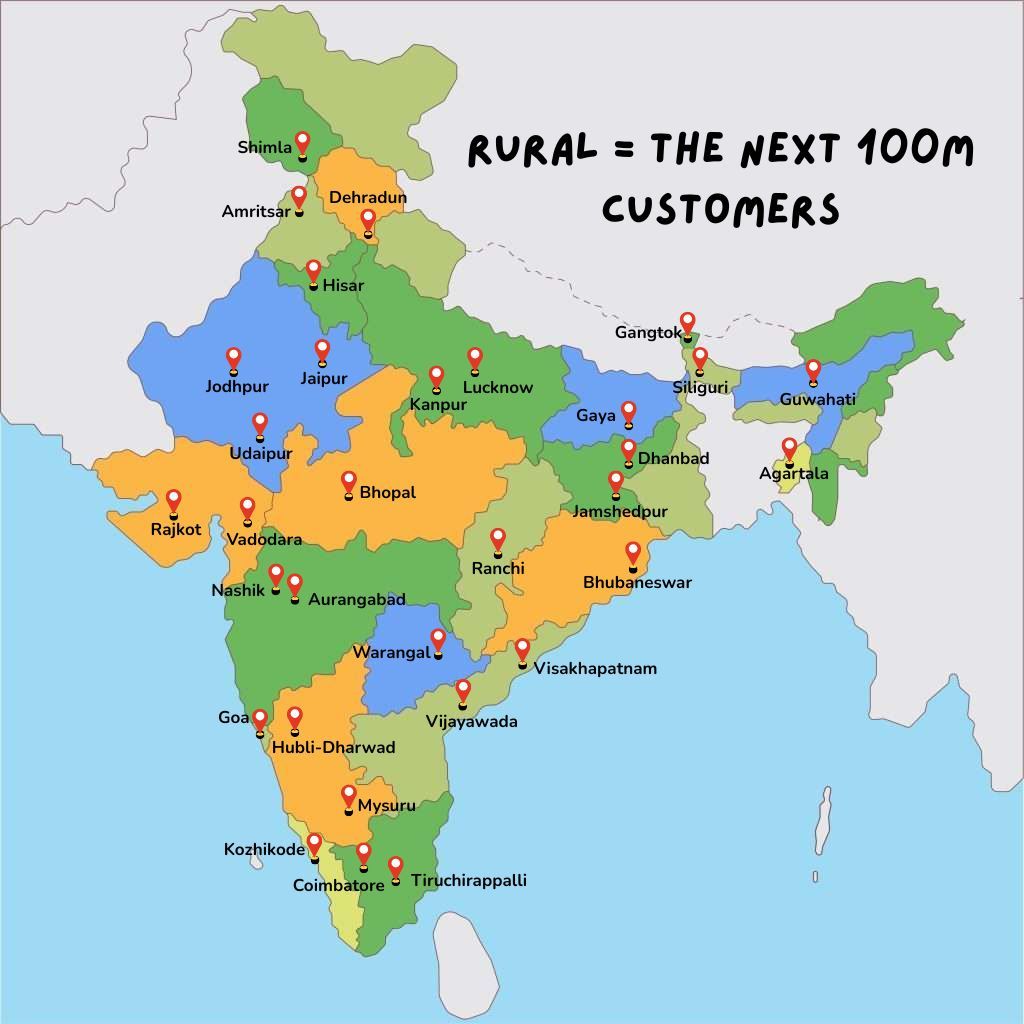
Several structural shifts have converged to make rural India a high-priority consumption market for FMCG brands:
Rising rural disposable incomes: Government programs, better crop prices, and increased non-farm employment have lifted rural purchasing power significantly over the past five years.
Tier-2 cities as retail hubs: Cities like Lucknow, Indore, Coimbatore, and Vadodara now have organized retail footprints that rival smaller metros. Kirana stores in these cities stock a wider SKU range and serve a more brand-conscious shopper than before.
Smartphone and data penetration: With over 700 million internet users, a large share of whom are rural, consumers are discovering brands online and buying them in local stores. Digital influence on rural purchase decisions has grown sharply.
Aspirational demand shifting category mix: Categories like premium personal care, packaged snacks, health drinks, and hygiene products are growing faster in rural and Tier-2 markets than in metros, where category penetration is already high.
Smaller outlets punching above their weight: The neighborhood kirana store in a Tier-3 town is often the fastest-moving FMCG outlet in its pin code. Brands that invest in these relationships early build durable distribution advantages.
Further Reading: FMCG Distribution Strategy for Tier-2 and Tier-3 India: A 2026 Playbook
The demand is there. The challenge lies in building operations that can actually serve it reliably. Most brands face a consistent set of field execution problems in Tier-2 and rural zones:
Manual, paper-based reporting: Many field reps in remote beats still rely on diaries, WhatsApp messages, and verbal check-ins. This creates reporting delays of 24 to 48 hours, making real-time management impossible.
No real-time rep tracking: Without GPS-based check-ins or digital visit logs, sales managers have limited visibility into whether planned beats are being executed.
Absence of structured beat planning: Rural territories are often large and poorly segmented. Reps end up revisiting familiar outlets while new or high-potential stores go untouched for weeks.
Zero outlet-level visibility: Brands know their primary sell-in figures but have little insight into what is actually moving off the shelf at individual kirana stores.
Delayed scheme communication: Promotional offers and trade schemes often reach field teams days after launch, leading to missed activation windows and distributor frustration.
Offline connectivity gaps: Digital tools that require a constant internet connection fail in areas where 4G coverage is patchy, making adoption low and data capture incomplete.
Each of these gaps seems small in isolation. In aggregate, they translate into missed orders, poor fill rates, and a field team that is working hard but not working smart.
Related: FMCG Distribution Challenges: How Smart Field Operations Fix What Manual Processes Break
Let’s be specific. A field sales representative covering a Tier-2 or semi-rural beat typically:
Covers 20 to 35 outlets in a single day
Travels 40 to 60 kilometers across two or three remote beats
Deals with network connectivity issues in nearly 40% of their territory
Takes orders manually and consolidates them at the end of the day
Tries to keep track of scheme changes, new SKUs, and distributor stock levels from memory or printed sheets
Now consider what happens when all of this runs on pen and paper in a region with unreliable signal. Orders get missed. Schemes do not get communicated. Outlet visits go unverified. The rep is doing their best, but the system is not built to support them.
The shift to a mobile-first, offline-capable sales tool does not replace the rep. It removes the friction so they can do more of what actually creates value: showing up, building relationships, and taking orders.
Also See: Beat Planning in Sales: The Complete FMCG Field Guide
Winning in Tier-2 and rural India is not just about adding more feet on the street. It is about making every visit count. Here are the operating model improvements that separate brands growing in these markets from those that are stalling:
Any tool deployed in rural territories must work without a stable internet connection. Offline-first sales apps allow reps to log orders, complete store audits, and record outlet data locally, with automatic sync when connectivity is restored. This eliminates the data gap that plagues manual reporting.
There is a difference between a rep knowing which area to visit and having a data-driven beat plan that optimizes for outlet potential, visit frequency, and travel efficiency. Brands that invest in structured beat planning see measurable improvements in outlet coverage, order frequency, and rep productivity.
Learn more: Beat Planning in Sales: The Complete FMCG Field Guide
Primary sell-in data tells you what left the warehouse. Secondary sales data tells you what is actually selling at the retail level. Brands that connect their distribution management systems to field reporting can spot stockouts, identify demand surges in specific pin codes, and intervene before problems compound.
Trade promotions are only effective if field teams know about them in real time. Digital scheme broadcasting through sales apps ensures reps can communicate offers to retailers at the point of visit, not three days later. This is one of the highest-ROI fixes for rural FMCG execution.
Visit counts are vanity metrics. What matters is the revenue generated per outlet, per beat, per rep. Sales managers who track outlet-level productivity can reallocate rep time to high-potential stores and reduce wasted visits to outlets with declining throughput.
Reference: 10 KPIs Every FMCG Sales Manager Must Track, With Benchmarks
India has an estimated 12 to 14 million kirana stores, and a significant proportion of them sit in Tier-2, Tier-3, and rural markets. These are not just points of sale. They are community anchors. Consumers in smaller towns are deeply loyal to their neighborhood kirana store owner, which means brand visibility at the kirana level translates directly into purchase decisions.
FMCG brands that build structured retailer engagement programs, consistent visit cadences, and loyalty incentives for kirana owners in these geographies tend to hold more shelf space and see lower out-of-stock rates than competitors who rely purely on distributor push.
Read more: Retailer Loyalty Programs for FMCG: How to Win Shelf Space and Market Share
Rural and Tier-2 India is the primary growth frontier for FMCG brands, with volume growth consistently outpacing urban markets.
The biggest execution gaps are manual reporting, poor beat planning, delayed scheme communication, and lack of outlet-level visibility.
Offline-first sales technology is not optional in low-connectivity rural zones—it is the foundational requirement for consistent data capture.
Structured beat planning and outlet productivity tracking are the two highest-impact operational changes a brand can make in rural markets.
Kirana store relationships remain the ultimate competitive moat in Tier-2 and rural FMCG. Brands that invest in retailer success will capture the lion’s share of tomorrow’s demand.
Rural India accounts for a major share of total FMCG consumption, and its volume growth has been outpacing urban markets in recent years. Rising incomes, stronger distribution, and aspirational consumption continue to expand the market.
Tier-2 cities offer faster income growth, rising organized retail, and stronger digital adoption. They also provide room for expansion when metro markets become more saturated.
The most common issues are weak connectivity, long travel distances, manual reporting, poor secondary sales visibility, and delayed field communication. These reduce efficiency and create blind spots.
Leading brands use offline-capable Sales Force Automation tools. These allow reps to log orders and visits even without internet, then sync data later for manager visibility.
Beat planning is the structured scheduling of outlet visits by day, route, and territory. It reduces wasted travel time and improves outlet coverage and productivity.
Rural consumers are becoming more brand-aware, more digitally influenced, and more willing to buy premium and packaged products. That is expanding demand across multiple categories.
Get notified about the next update






 Salesforce Automation
 CRM & Lead Management