
Quick Answer- Most building material distributors lose money not because of weak demand, but because of operational gaps. Inventory mismatches, manual order handling, unoptimized delivery routes, and
Quick Answer- Most building material distributors lose money not because of weak demand, but because of operational gaps. Inventory mismatches, manual order handling, unoptimized delivery routes, and disconnected teams silently drain margins every day. Modern distribution management systems address these issues by connecting stock, orders, field teams, and analytics into a single platform, letting operators make faster, more accurate decisions.
If you move cement bags, TMT steel bars, tiles, AAC blocks, or timber for a living, you know this business is not forgiving. Project timelines are tight. Dealers want answers fast. Delivery windows at construction sites are narrow. And the margin between a profitable quarter and a painful one is thinner than most people outside the industry realize.
Here is what is surprising: most of the money that slips out of a building materials distribution business does not disappear because of bad market conditions or aggressive competition. It disappears quietly, through small operational failures that add up fast.
Wrong item dispatched. Delivery truck sitting half-empty. Stock counted incorrectly in the warehouse. Invoice sent three days late. Each of these feels minor in isolation. Together, they represent a structural drag on your bottom line.
The good news is that these are solvable problems. And the distributors who are pulling ahead right now are solving them in a specific, methodical way.
Before talking about solutions, it helps to be precise about where losses actually originate. Broadly, they fall into five categories.
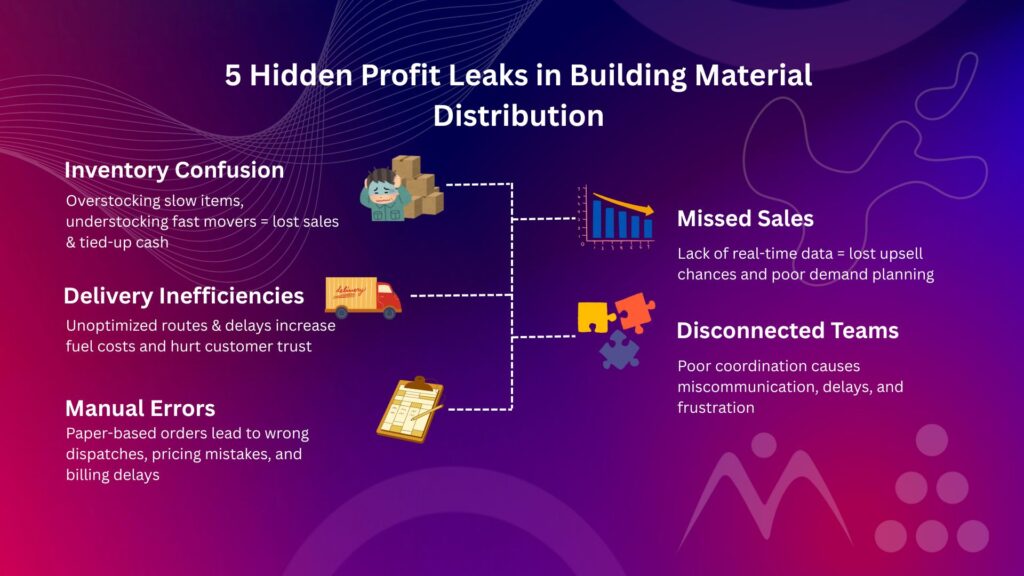
Multi-location inventory is genuinely hard to manage without the right systems. When stock data lives in spreadsheets or separate software that does not sync in real time, you end up in a situation where the warehouse says 200 bags are available, your sales rep commits to the order, and at dispatch time the actual count is 140.
The downstream effect is a delayed order, an unhappy dealer, and a construction site that loses half a day waiting for materials. Multiply this across hundreds of SKUs and several depots, and it becomes a significant operational cost.
On the other side, over-purchasing slow-moving materials ties up working capital and increases warehousing costs. Both problems come from the same root cause: lack of real-time visibility across your distribution network.
Delivering bulky construction materials to scattered project sites and dealer outlets requires coordination. Without route optimization, field teams often make decisions on the fly. Trucks take longer routes. Two deliveries that could be batched go out separately. Half the truck capacity goes unused.
Fuel costs in logistics-heavy industries like building materials can represent 15 to 20 percent of operational expenses. Even a 10 percent improvement in route efficiency has a direct, measurable impact on profitability.
A surprisingly large number of distributors still accept orders through informal channels. A dealer calls the sales rep. The rep passes it to the office via ChatApp. Someone at the office enters it manually into a system or, worse, a spreadsheet.
Every handoff in this chain introduces error risk. Wrong product code. Wrong quantity. Wrong delivery address. Wrong pricing tier for that particular dealer. Manual order management works at low volumes but breaks down as a business grows, and the errors it creates are often not caught until after dispatch.
Field sales representatives in building materials typically cover large territories with dozens of dealers. When they walk into a dealer meeting without knowing that dealer’s last three orders, current outstanding credit, or which products are running low, they are operating at a disadvantage.
They cannot upsell effectively. They cannot flag a dealer who has gone quiet. They cannot prioritize visits based on revenue potential. Reviewing the common SFA challenges in building materials industry makes it clear why traditional tools fail to support field teams adequately. Good data in the hands of field reps directly translates to better coverage, higher order values, and faster identification of at-risk accounts.
When your sales team, warehouse team, logistics team, accounts team, and dealer network are all working off different systems and different information, friction is the natural result. Orders that should take two hours take a day. Disputes about billing stretch into weeks. Decisions that require cross-department coordination get delayed because nobody has a shared picture of what is actually happening.
| Manual Operations vs. Connected Distribution System at a Glance | ||
|---|---|---|
| Dimension | Manual Process | With Distribution System |
| Inventory Visibility | End-of-day stock count, often inaccurate | Real-time across all warehouses |
| Order Placement | Phone/WhatsApp, high error rate | Digital, validated at entry |
| Delivery Planning | Manual, driver decides route | Optimized routes, GPS tracked |
| Sales Rep Access | Calls office for stock/pricing | Live data on mobile app |
| Reporting | Monthly spreadsheets | Daily dashboards, drill-down analytics |
| Billing | Manual, delays common | Auto-generated at dispatch |
The most profitable building material distributors in the current market share a few things in common. They have not necessarily made massive technology investments. But they have been deliberate about connecting their operations.
Real-time inventory management is the foundation. When your warehouse team, sales team, and dealer-facing team all see the same stock numbers at the same moment, a large category of problems simply disappears. Orders get placed against accurate availability. Dealers stop receiving calls saying the material they ordered last week is not in stock.
Distributors who have moved to real-time inventory systems consistently report fewer order cancellations, faster fulfillment cycles, and better working capital utilization because they stop tying money up in materials that are not moving.
When an order comes in digitally, the system checks stock, generates a picklist, confirms pricing against that dealer’s tier, and triggers an invoice. The sales rep gets a confirmation. The warehouse team gets a dispatch instruction. This entire sequence can happen in under a minute without a single person manually transcribing data from one place to another.
For distributors still running on calls and WhatsApp, this sounds almost too simple. But the operational difference is significant. Errors drop. Order processing time drops. Customer confidence goes up.
Sales force automation gives field representatives access to live stock levels, dealer order history, current pricing, and active schemes from their phone. Before walking into a dealer meeting, a rep can see exactly what that dealer last ordered, what promotions they qualify for, and whether there are any outstanding payment issues to address.
This changes the quality of those conversations. Instead of relaying information between the dealer and the office, the rep becomes a decision-maker on the spot. Orders close faster. Dealers feel better served. And managers get visibility into what their field teams are actually doing, without relying on end-of-day call reports that may or may not be accurate.
The shift from reactive to proactive operations is where the biggest margin improvements tend to happen. When managers can see which SKUs are trending up three weeks before a stockout, they can reorder in time. When they can see that a particular dealer’s order frequency has dropped, they can send a rep before that dealer moves to a competitor.
This kind of operational intelligence does not require a data science team. It requires a system that captures the right data automatically and presents it in a usable format. Modern distribution platforms do this through dashboards and automated alerts that flag anomalies without requiring anyone to run a report.
A distribution management system (DMS) is a connected platform that handles the full operational cycle of a distribution business: from order placement and inventory management to delivery tracking, dealer engagement, invoicing, and analytics.
For building material distributors specifically, the key capabilities to look for include:
The goal is not to automate everything. The goal is to remove the friction from the high-frequency, error-prone tasks so your team can focus on decisions that actually require human judgment.
For more on managing inventory across a multi-location distribution network, read Mastering Inventory Challenges: A Guide for CPG Distributors, or see the top operational mistakes distributors make and how software addresses each one.
Not every distribution business needs to overhaul its systems immediately. But these are signals that the current approach is creating a ceiling on growth:
If more than two of these describe your current situation, the issue is not individual performance or effort. It is the infrastructure your team is working within.
Building material distributors deal with high logistics costs, bulky goods, scattered delivery sites, and manual order handling. Without real-time inventory visibility and automated workflows, small inefficiencies compound quickly. Fuel waste, stock mismatches, and missed deadlines all cut into already thin margins. The root cause is usually operational rather than market-driven.
A distribution management system is a software platform that connects order management, inventory tracking, invoicing, delivery routing, and dealer communication in a single place. For building material distributors, it replaces fragmented manual processes with a unified digital workflow, reducing errors and improving fulfillment speed.
Real-time inventory tracking lets distributors see exact stock levels across all warehouses instantly. This prevents overstocking slow-moving materials, avoids stockouts on fast-selling items, and speeds up order fulfillment. It also helps field sales teams quote accurately without calling the warehouse.
Clear signals include frequent stock discrepancies, customer complaints about delivery delays, billing errors requiring manual correction, and field sales teams relying on phone calls for basic information. If more than 30 percent of working time is spent on manual data entry or reconciliation, it is worth evaluating a modern distribution management system.
The most common mistakes include managing orders through informal channels like phone calls and WhatsApp, maintaining separate spreadsheets for inventory and billing, using manual route planning for deliveries, and lacking unified dashboards for sales performance. These create data silos, delay decisions, and make scaling difficult.
Sales force automation gives field representatives a mobile app to place orders, check real-time stock and pricing, view dealer history, and log visits. For building material companies with multi-tier channels including dealers, contractors, and project site buyers, SFA reduces order cycle time and gives management live performance data.
Building material distribution is a hard business. The margins are tight, the logistics are complex, and the customers are demanding. But a large share of the losses that distributors experience are not inevitable. They are the direct result of operational gaps that can be addressed with the right systems and processes.
The distributors gaining ground right now are not doing anything exotic. They have connected their inventory, their orders, their field teams, and their data. That connectivity removes the friction that was previously costing them money every single day.
If you want to go deeper on the operational side of building material distribution, see how omnichannel distribution models integrate with modern DMS platforms, or explore the KPIs every sales manager in distribution should be tracking.
Get notified about the next update






 Salesforce Automation
 CRM & Lead Management