Can AI Truly Predict Retailer Sentiment?
By Harshit Rajput
/ April 20, 2026
The legendary Peter Drucker once said, 'The most important thing in communication is hearing what isn't said.' In the world...
Read More

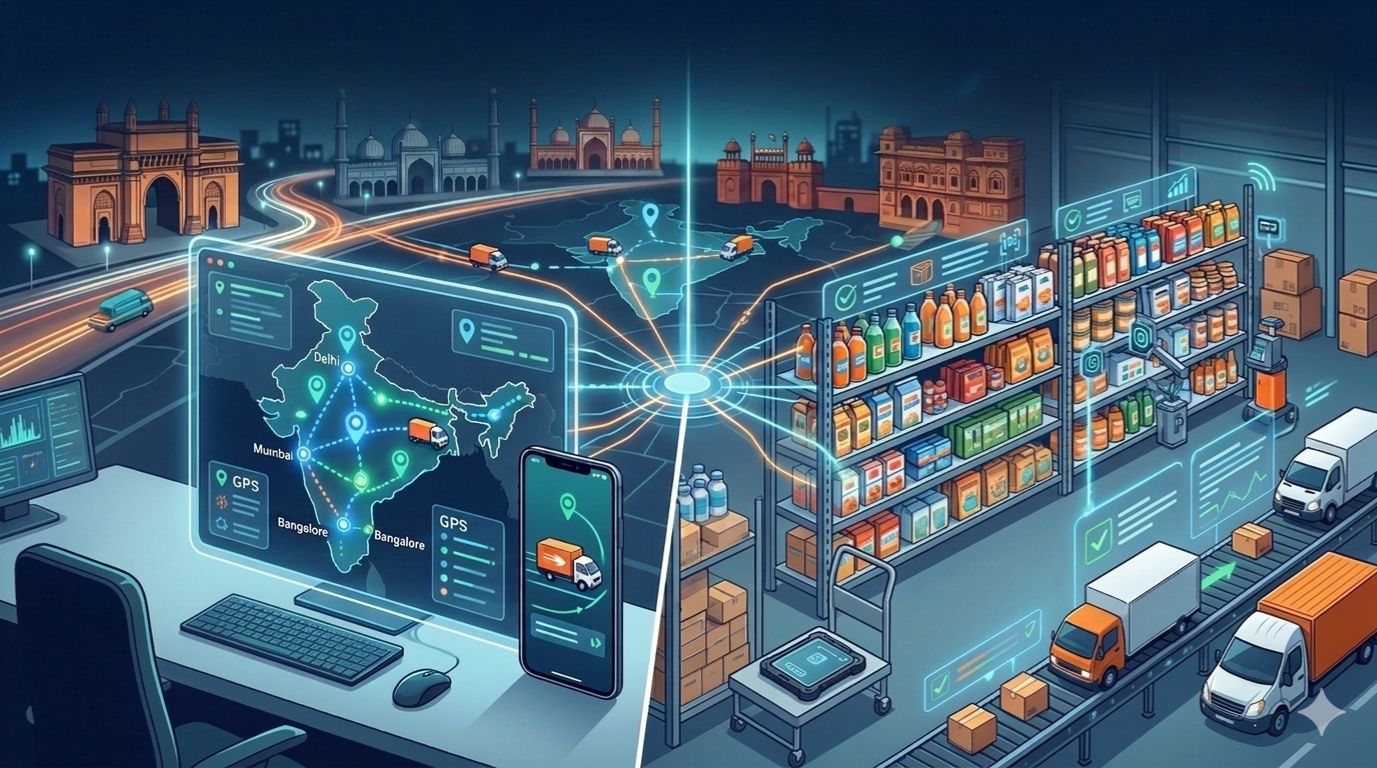
Managing FMCG distribution in India has never been a simple task. A product manufactured in one state must reach a kirana store in a tier-3 town, sometimes through three or...
Managing FMCG distribution in India has never been a simple task. A product manufactured in one state must reach a kirana store in a tier-3 town, sometimes through three or four intermediaries, all within a window when freshness, scheme compliance, and stock availability must align perfectly.
For years, this worked, roughly. Paper-based orders, phone calls, and manual reconciliation held the network together. But as India’s FMCG market has scaled, the cracks in that model have widened. Stockouts happen too often. Claims go unresolved. Sales reps spend more time chasing data than building relationships.
Something had to change.
Today, technology is quietly but significantly reshaping how distribution works across India’s supply chains. And at the center of that shift is one category of software that is becoming indispensable: the Distribution Management System, or DMS.
This blog explores what that transformation actually looks like on the ground, why it is happening now, and how platforms like MAssist are helping FMCG brands get ahead of it.
India’s FMCG sector is one of the most complex distribution environments in the world. A single brand can have hundreds of distributors, thousands of retailers, and field teams spread across geographies with varying connectivity and digital literacy.
For a long time, this complexity was managed through sheer human effort. Salespeople made calls. Distributors maintained their own records. Claims were raised on paper and took weeks to resolve. Returns were tracked manually or not at all.
The result was a distribution network that functioned, but not efficiently. Common problems included:
This was not a people problem. It was a systems problem. And as consumer demand grew, as India’s retail footprint expanded into tier-2 and tier-3 cities, and as GST compliance became mandatory, the gap between what manual systems could handle and what the market demanded grew too large to ignore.
Several forces have converged over the past few years to make digital distribution not just attractive but necessary.
GST-compliant invoicing, e-way bill generation, and e-invoicing mandates have made paper-based systems a liability. Businesses need software that generates compliant invoices automatically, reduces errors, and stays current with regulatory requirements. Manual billing simply cannot keep pace.
India’s consumption story is increasingly rural. According to Nielsen, rural markets now account for a significant and growing share of FMCG volume. Reaching these markets efficiently requires distribution infrastructure that works in low-connectivity environments and scales without adding proportional headcount. For a deeper look at this shift, see our piece on winning in tier-2 and tier-3 markets.
FMCG brands compete not just on product quality but on shelf presence and availability. A competitor that can replenish faster, execute schemes more accurately, and respond to stockouts in hours rather than days has a real advantage. That kind of speed is only possible with real-time data.
Modern FMCG distribution is no longer just general trade and modern trade. Quick commerce, e-commerce, and direct-to-retail channels have added complexity that traditional systems were never designed to handle. Brands need a platform that manages all these channels from a single interface.
A Distribution Management System is software built specifically to manage secondary sales and distributor operations. If you want a full breakdown of what DMS is and how it works, our dedicated guide covers that in detail. What this blog focuses on is what changes when one is actually deployed.
Here is what becomes possible with a modern DMS like MAssist in place:
Instead of waiting for weekly stock reports or calling distributors to check availability, manufacturers can see live inventory levels across every distributor and warehouse. Redistribution decisions happen proactively, not reactively. Stockouts become the exception rather than the norm.
Field reps and distributors place orders through a mobile app rather than phone calls or WhatsApp messages. Orders are validated instantly, invoices are generated automatically, and the entire transaction is logged without manual entry. This alone eliminates a significant volume of errors and delays.
Trade schemes are one of the most administratively painful parts of FMCG distribution. With MAssist, schemes are configured once and applied automatically at every transaction. There is no room for misapplication, and disputes are rare because the audit trail is always there.
Distributors log returns by reason code, whether expired, damaged, or short-supplied, and the system automatically initiates a claim workflow. Finance teams no longer spend days reconciling paper-based claims. Legitimate claims are resolved faster, and false claims are identified earlier.
Sales managers and leadership teams get visibility into distributor performance, outlet-level fill rates, SKU movement, and territory trends in real time. Decisions that used to be made on gut feel or month-end reports can now be made on the same day the data is generated. For FMCG sales managers tracking specific KPIs, this is transformative.
MAssist is designed to work within your existing technology stack, not replace it. It connects with ERP systems, CRM platforms, and Sales Force Automation tools so that data flows seamlessly across departments. There is no duplication, no manual export-and-import, and no information sitting in silos.
The impact of distribution digitization is not abstract. Each part of the supply chain feels it in practical ways.
Many DMS platforms are designed for global markets and retrofitted for India. MAssist is built from the ground up for the realities of Indian FMCG distribution.
That means several things practically:
MAssist also handles multichannel stock points, including scenarios where the same organization runs different distributor structures in different geographies. The system adapts dynamically, which matters for brands with uneven distribution maturity across regions.
It would be dishonest to say that digitizing distribution is straightforward. Resistance to change is real, especially among distributors who have managed their operations the same way for decades.
The concerns are legitimate. A new system means a learning curve. It means entering data that previously stayed in someone’s head or in a handwritten ledger. It means accountability that did not exist before.
MAssist approaches this with honesty and practical support:
The goal is not to replace the way people work. It is to give them better tools for doing the same work with fewer errors, less effort, and more visibility.
The digitization underway today is just the foundation. Across the industry, a second wave of change is already taking shape.
AI-powered demand forecasting is reducing the guesswork in inventory planning. Instead of relying on historical averages, brands can predict demand at the outlet level before it shows up in orders. Platforms like MAssist are incorporating these capabilities so that brands can stay ahead of trends rather than respond to them.
IoT-connected warehouses are beginning to provide real-time visibility into temperature, humidity, and movement, which matters significantly for FMCG categories with shelf-life sensitivity.
The rise of agentic AI in field sales means that systems can soon take autonomous action, triggering replenishment, flagging coverage gaps, and adjusting route plans, without waiting for a human to notice the issue. We have written more about this shift in our piece on autonomous order booking and agentic AI in sales.
All of this relies on a distribution layer that is already digital. Brands that invest in digitizing their supply chains today are not just solving today’s problems. They are building the infrastructure that tomorrow’s capabilities will run on.
India’s FMCG sector is growing, and the brands that grow with it will be the ones that can execute consistently at scale. That means real-time distribution visibility, accurate scheme execution, faster claims resolution, and the kind of data that makes every decision smarter.
Manual systems had their moment. The complexity of modern FMCG distribution across India’s diverse geographies has simply outgrown them.
Technology is not a luxury for brands that want to compete. It is the operating infrastructure that distribution now requires.
If you are evaluating how to modernize your distribution network, MAssist offers a practical, India-specific path to getting there. Talk to our team to understand what that looks like for your business.
It means replacing paper-based, manual, or disconnected processes in distribution with software that connects all stakeholders in real time. This includes order capture, invoicing, inventory visibility, scheme execution, returns management, and performance reporting on a single integrated platform.
A Distribution Management System is the primary tool through which digitization happens, but the broader transformation involves how every participant in the supply chain, from manufacturer to retailer, works together. Digitization changes workflows, accountability structures, and the speed at which decisions are made. The DMS is the enabler; the transformation is the outcome.
MAssist provides a DMS platform built specifically for the complexity of Indian FMCG operations. It offers real-time stock tracking, mobile-based order management, automated scheme execution, claims management, and deep integration with ERP and CRM systems. It is designed to work in low-connectivity environments and supports multiple languages for field adoption across diverse regions.
The most common challenges involve change management rather than technology itself. Distributors and field teams may be unfamiliar with digital tools, and adoption takes effort. Other challenges include integrating with existing ERP or accounting systems and ensuring the platform works reliably in areas with poor internet connectivity. MAssist addresses all three through intuitive design, offline functionality, and API-based integrations.
Yes. A modern DMS generates GST-compliant invoices and supports e-invoicing and e-way bill generation as part of the billing workflow. This reduces manual compliance effort significantly and minimizes the risk of errors in tax documentation.
 Channel Management
Distributor Management System
Field Force Management
Growth Strategies
Industry Insights
Inventory & Visibility
Market Intelligence (RTM Strategy)
Performance Analytics
Predictive Analytics
Retail Execution
Sales Force Automation
Secondary Sales & Order Booking
Specialized Sales Roles
Tech & AI
Channel Management
Distributor Management System
Field Force Management
Growth Strategies
Industry Insights
Inventory & Visibility
Market Intelligence (RTM Strategy)
Performance Analytics
Predictive Analytics
Retail Execution
Sales Force Automation
Secondary Sales & Order Booking
Specialized Sales Roles
Tech & AI
Get notified about the next update